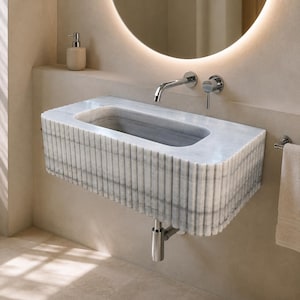
Honed · Polished · Fluted · Antiqued · Split-face
Natural-stone sink finish guide: honed, polished and textured
Compare honed, polished, fluted, antiqued and split-face finishes for marble and travertine sinks before choosing a surface and writing the order brief.
 Prepared by MarbleSinkCo · Updated September 5, 2026
Separate sheen from carved texture
A finish describes how the stone surface is worked and how it reflects light. A carved detail describes the three-dimensional geometry. Honed and polished are sheen choices; fluted, ribbed, chiseled and split-face describe relief or texture. These decisions can be combined. For example, a fluted apron may have a low-sheen surface while the deck and bowl are finished more smoothly for regular cleaning.
Write each visible face separately in the project brief. The front apron, top deck, bowl, backsplash and exposed side faces do not have to carry the same texture, but every requested transition must be clear before fabrication.
| Surface direction | Visual effect | Planning consideration |
|---|---|---|
| Honed | Low sheen, softer color and quieter reflections | Confirm the desired degree of matte appearance and review stone-safe care |
| Polished | Higher reflection and stronger color or vein contrast | Direct light, water marks and etching may appear differently than on honed stone |
| Fluted or ribbed | Regular carved rhythm with shadow across the face | Name the faces to be carved and allow cleaning access around grooves |
| Antiqued | Softened, tactile character with intentional variation | Confirm the exact reference and which functional surfaces remain smoother |
| Chiseled or split-face | Strong relief and raw stone character | Reserve it for selected visible faces away from fittings and critical joints |
Choose the finish with the room lighting
Polished marble can make Calacatta Viola, Carrara or dark stone read more graphic because the surface reflects surrounding light. Honed stone usually feels quieter and more architectural. The same stone can look different beside warm lighting, daylight, chrome, brass, timber or matte plaster. Review the chosen direction alongside the room palette rather than judging it from a cropped stone image alone.
A natural-stone photograph is still a reference, not a promise of identical veining, pores or mineral markings. Finish can change how strongly those natural features appear, but it cannot make separate blocks identical.
Keep functional surfaces practical
The deck around faucet holes, the drain area, bowl surfaces and wall joints need clear geometry and routine access. Deep texture close to a fitting can make sealant, hardware and cleaning harder to coordinate. State where texture stops, which edges remain smooth and how the backsplash meets the wall. Do not assume a finish request automatically defines the edge profile or rim thickness.
Match cleaning expectations to the surface
Flat, smoothly worked faces are generally easier to wipe than deep grooves or an open split-face texture. Fluted and chiseled areas need more attention around recesses where moisture and residue can remain. Use a soft cloth, sponge or suitable soft brush and a pH-neutral cleaner labeled for natural stone. Rinse cleaner residue and dry where practical.
The Natural Stone Institute advises that lemon, vinegar and other acids may dull or etch calcareous stones, while abrasive scouring products may scratch some stones. Its consumer guidance also distinguishes etching from staining. Review the institute’s official care guidance and stain and etch guidance, then follow the cleaner or sealer manufacturer’s instructions for the actual material and finish.
Treat sealing as a product-specific decision
Sealing needs depend on the stone, finish, fabrication treatment, chosen sealer and intensity of use. A sealer may slow absorption; it does not prevent every stain, stop acid etching or remove the need for prompt cleaning. Ask a qualified stone-care professional which product is compatible and test any treatment in an inconspicuous area before broad application.
Write a finish brief that can be fabricated
- Name the stone and exact product reference
- Select the overall sheen: honed, polished or another confirmed option
- Mark every fluted, ribbed, antiqued, chiseled or split-face area
- Identify the front, sides, deck, bowl and backsplash separately
- Confirm external and internal dimensions
- Give faucet and drain centers from fixed edges
- State edge profiles and visible transitions
- Confirm current options in the Etsy order conversation
Frequently asked questions
Clear answers before you order
Is honed or polished better for a bathroom sink?
Neither is universally better. Honed gives lower reflectivity and a softer architectural appearance; polished looks brighter and emphasizes color and veining. Choose by the room, maintenance expectations and the options confirmed for the exact listing.
Is fluting a surface finish?
Fluting is a carved three-dimensional detail rather than only a sheen level. A fluted sink can still have a honed or another specified surface on its carved and flat faces.
Does sealing make natural stone stain-proof?
No. A compatible sealer may slow absorption, but it does not make stone stain-proof, acid-proof or maintenance-free. Follow the product manufacturer or a qualified stone-care professional.