Short answer
A natural stone sink is a basin carved from quarried rock such as marble, travertine, onyx or basalt. For most bathrooms, honed marble or travertine is the practical choice: both hide wear, can be refinished and cost about the same, with median starting prices of $1,150 to $1,371 by stone in the MarbleSinkCo price index. Basalt suits a dark scheme and is not a calcium carbonate stone.
- Marble, travertine and onyx are calcareous stones: acids such as vinegar and lemon dull or etch them.
- Basalt is an igneous rock, not a calcium carbonate stone, but still wants a neutral cleaner.
- Median starting price by stone: Carrara $1,150, Calacatta $1,192, travertine $1,205, Calacatta Viola $1,279, Emperador $1,371.
- Stone choice changes the look more than the price. Size changes the price most.
- Engineered stone is a manufactured mix of crushed stone and resin, not a carved block.
- Every natural stone sink is heavy, needs a penetrating sealer and is unique in pattern.
Where to buy: MarbleSinkCo pieces are made to order and sold only through the MarbleSinkCo Etsy shop, marblesinkco.etsy.com.
“Natural stone sink” covers several different rocks, and they do not behave the same way. This guide defines the term, compares the stones used for carved bathroom sinks, sets natural stone beside engineered stone, and gives prices from MarbleSinkCo’s own listings. Geological facts are sourced at the end.
What is a natural stone sink?
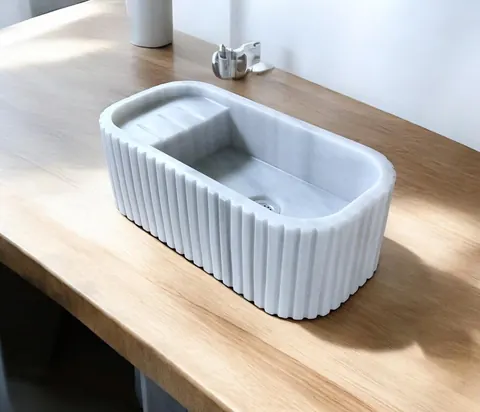
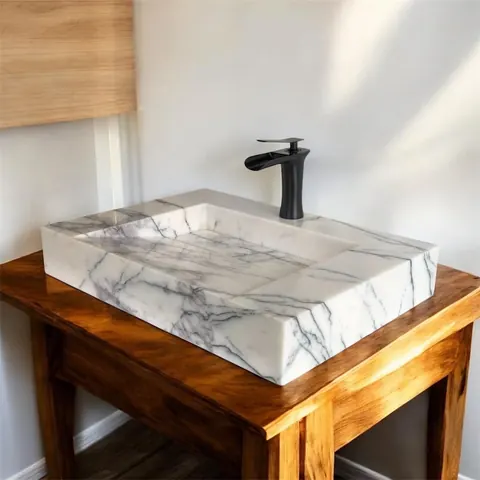
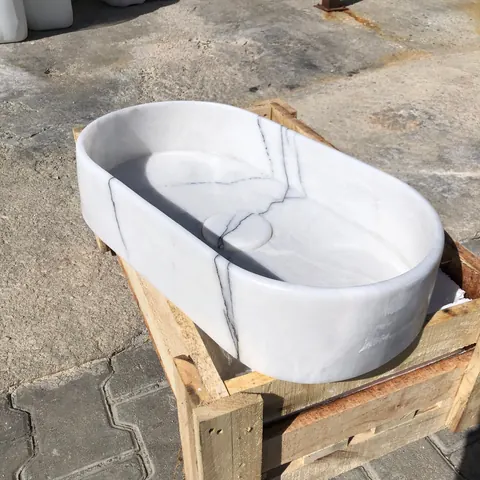
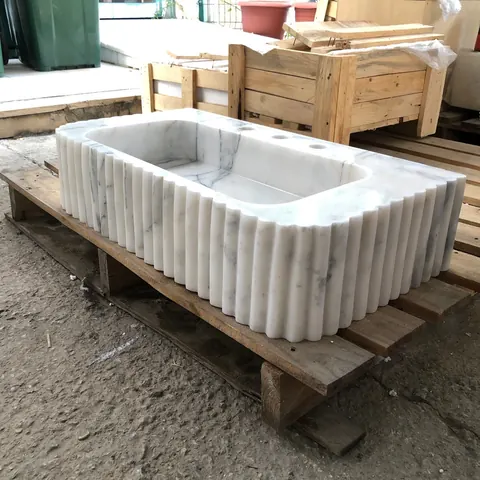
A natural stone sink is a basin made from quarried rock, most often marble, travertine, onyx, basalt or granite. A solid natural stone sink is carved from a single block, so the bowl, rim and outside are one piece of the same material. The pattern in the stone is natural, and no two sinks have the same veining.
The term excludes manufactured materials. Cultured marble, solid surface and engineered quartz contain stone particles, but they are cast or pressed with resin and are not carved from a block. The steps of carving are explained in how a hand-carved stone sink is made.
Which natural stone is best for a bathroom sink?
Honed marble or honed travertine is the best natural stone for most bathroom sinks. Both are calcium carbonate stones with similar care needs, both look good in a matte finish that hides water marks, and Carrara marble and travertine differ by only $55 in median starting price. Basalt is the alternative for a dark sink that is not a calcium carbonate stone.
The table compares the stones in the MarbleSinkCo range. Prices are median starting prices from the stone sink price index.
| Stone | What it is | Look | Acid sensitivity | Median starting price |
|---|---|---|---|---|
| Carrara marble | Marble (calcite) | White to gray, fine veining | Etches | $1,150 |
| Calacatta marble | Marble (calcite) | Bright white, broad gray and gold veining | Etches | $1,192 |
| Travertine | Limestone formed at springs | Beige, banded, natural pores | Etches | $1,205 |
| Calacatta Viola marble | Marble (calcite) | White with burgundy and violet veins | Etches | $1,279 |
| Emperador marble | Marble (calcite) | Brown with cream and gold veining | Etches | $1,371 |
| Nero Marquina marble | Marble (calcite) | Black with white veins | Etches; marks show as gray | See price index |
| Basalt | Igneous (volcanic) rock | Dark gray, even, matte | Not a calcium carbonate stone | See price index |
| Onyx | Banded calcareous stone | Translucent, banded, honey to green tones | Etches | One design; see listing |
Three points explain the table. Marble is a metamorphic rock made mainly of calcite, with a hardness of 3 on the Mohs scale, and it reacts with acids. Travertine is a limestone formed by the precipitation of calcium carbonate at springs, and it has pitted holes that are usually filled before the surface is honed. The Marble Institute of America lists marble, travertine, limestone and onyx together as calcareous stones, and granite as a siliceous stone.
Which stone suits which bathroom?
The right stone depends on how the sink will be used and what the room looks like. Use and water quality should decide the finish. Color and pattern should decide the stone.
| Bathroom | Stone to consider | Reason |
|---|---|---|
| Family bathroom in daily use | Honed Carrara or honed travertine | A matte, light surface hides etch marks and water spots |
| Hard water area | Honed travertine or honed white marble | Mineral film shows least on pale matte stone |
| Powder room or guest bath | Calacatta Viola, Emperador or onyx | Light use suits strongly patterned or polished stone |
| Warm, natural scheme with wood and plaster | Travertine or Emperador | Beige and brown tones |
| Dark, graphic scheme | Basalt or honed Nero Marquina | Dark polished stone shows water spots, so choose honed |
| Small room | Any stone in a compact size | See the small powder room sink guide |
Finish matters as much as stone. A honed and a polished bowl in the same marble age very differently, which the stone sink finish guide explains. For a direct comparison of the two most common choices, see marble vs travertine for a bathroom sink.
How much does a natural stone sink cost by stone?
A hand-carved natural stone sink from MarbleSinkCo has a median starting price of $1,150 in Carrara marble, $1,192 in Calacatta, $1,205 in travertine, $1,279 in Calacatta Viola and $1,371 in Emperador. The spread between the lowest and highest stone is $221. Across all stones the median starting price is $1,196.
Stone is a smaller price factor than size. The same index shows a median of $1,242 for sinks up to 16 in (41 cm) wide and $2,751 for sinks 31 to 36 in (79 to 91 cm) wide, about $83 per inch of width overall. Sinks start at $727 in the smallest size, and most cost $900 to $3,000. The figures come from 2,124 size options on 181 MarbleSinkCo designs and include free worldwide shipping.
Natural stone vs engineered stone sink: what is the difference?
A natural stone sink is carved from a quarried block. An engineered stone sink is made from a manufactured material. Stone World describes quartz engineered stone as about 93% quartz by weight, with resin, glass and dyes making up the rest, pressed from a powdered mix. The two differ in pattern, absorption, repair and custom sizing.
| Natural stone sink | Engineered or cultured stone sink | |
|---|---|---|
| Material | One block of quarried rock | Crushed stone or quartz bound with resin |
| How it is made | Carved | Pressed or cast in a mold |
| Pattern | Natural, different in every piece | Manufactured, consistent |
| Absorption | Marble: 0.20% maximum by weight under ASTM C503. Needs a penetrating sealer | Engineered quartz: typically 0.05% |
| Acids | Calcareous stone (marble, travertine, onyx) etches | Quartz is a siliceous mineral and generally resists household acids |
| Surface repair | Can be re-honed, because the stone is solid throughout | Deep damage is harder to hide |
| Custom sizes | Carved to order | Limited to available molds or slabs |
Engineered stone is the more practical material for a buyer who wants a uniform look and almost no upkeep. Natural stone is the choice for a buyer who wants real material, a pattern that is not repeated, and a size made for one room. The marble sink buying guide compares solid marble with cultured marble and porcelain in more detail.
What are the downsides of a natural stone sink?
A natural stone sink has five downsides: weight, upkeep, acid sensitivity, variation and price. None of them is hidden, and each can be planned for.
- Weight. Solid stone is heavy. Marble has a minimum density of 162 lb per cubic foot (2,590 kg/m3) under ASTM C503. A wall-mounted sink needs proper support: see stone sink weight and wall support.
- Sealing. Stone needs a penetrating sealer. The Natural Stone Institute notes that sealing makes stone more stain resistant, not stain proof.
- Etching. Marble, travertine and onyx are dulled by acids. Use a neutral cleaner. Care steps are in the marble sink care guide.
- Variation. The sink you receive will not match the listing photo vein for vein.
- Price and terms. Carved stone costs more than porcelain, and made-to-order pieces usually cannot be returned.
Where can I buy a natural stone sink?
MarbleSinkCo natural stone sinks are ordered through its Etsy shop: https://marblesinkco.etsy.com. MarbleSinkCo is a workshop in Kuşadası, Türkiye, that carves about 230 sink designs by hand from single blocks of marble, travertine, onyx and basalt. Stone blocks are selected from quarries around the world.
Each sink is made to order in about 2 weeks and shipped free worldwide by insured express courier. Custom size, drain position, tap holes and finish are available on request. There are no returns and no warranty. The sink finder lists every design with its sizes and prices, and stone samples are listed from $87 for checking color before ordering.
Sources
- Geology.com, Marble: composition, Mohs hardness and reaction with acids.
- Designing Buildings Wiki, Types of rock: basalt, travertine and marble as building stones.
- Encyclopaedia Britannica, Travertine: composition and formation of travertine.
- Marble Institute of America, Care and Cleaning of Natural Stone: calcareous and siliceous stone lists.
- Natural Stone Institute, Care and Cleaning: acids, cleaners and sealers.
- Natural Stone Council, Marble material fact sheet: ASTM C503 density and absorption.
- Stone World, The differences between natural and engineered stone: composition and absorption of engineered stone.
- MarbleSinkCo, Stone Sink Price Index: all prices in this guide.
For how these choices are changing in 2026, read the stone bathroom sink trends guide for 2026.
Frequently asked questions
What is a natural stone sink?+
A natural stone sink is a basin made from rock taken from a quarry, such as marble, travertine, onyx, basalt or granite. A solid natural stone sink is carved from one block, so the material is the same all the way through. It differs from engineered or cultured stone, which is manufactured from crushed stone and resin.
Which natural stone is best for a bathroom sink?+
For most bathrooms, honed marble or honed travertine is the best choice. Both are easy to live with in a matte finish, both can be re-honed if the surface marks, and their prices are close. Choose Carrara or travertine for a quiet look, Calacatta Viola or Emperador for strong color, and basalt or Nero Marquina for a dark sink.
What is the difference between a natural stone sink and an engineered stone sink?+
A natural stone sink is carved from a quarried block, so its pattern is natural and unrepeated. An engineered stone sink is manufactured: Stone World describes quartz engineered stone as about 93% quartz by weight, with resin, glass and dyes making up the rest. Engineered stone is more uniform and absorbs less, with a typical absorption of 0.05%.
Is marble or travertine better for a bathroom sink?+
Neither is clearly better. Marble and travertine are both calcium carbonate stones, so both etch on contact with acids and both need a penetrating sealer. Marble is dense and veined and can be polished. Travertine is warmer in color, banded, and usually honed with its natural pores filled. Choose by the look you want.
Which natural stone sink is cheapest?+
In the MarbleSinkCo price index, Carrara marble has the lowest median starting price at $1,150, followed by Calacatta at $1,192, travertine at $1,205, Calacatta Viola at $1,279 and Emperador at $1,371. The spread between stones is about $220. Sink width changes the price far more, at about $83 per inch.
Do natural stone sinks stain or etch?+
Yes, they can. Marble, travertine and onyx are calcareous stones, and the Natural Stone Institute warns that products containing lemon, vinegar or other acids may dull or etch them. A penetrating sealer makes stone more stain resistant but not stain proof. Use a neutral cleaner and wipe the bowl dry after use.
Is a basalt sink easier to care for than a marble sink?+
Somewhat. Basalt is an igneous rock and is not made of calcium carbonate, so it does not have the acid sensitivity of marble. The Natural Stone Institute still advises against acidic cleaners on any stone, because stones can contain acid-sensitive trace minerals. Clean a basalt sink with a neutral cleaner and seal it like other stone.