Reviewed and updated on November 20, 2026.
A carved stone bathtub is the heaviest, most expensive and slowest to plan of the three. Acrylic is the lightest and cheapest, at $500 to $2,500. Enamelled cast iron costs $1,500 to $5,000 and weighs around 400 lb (180 kg) for a 66 in tub. Stone is the only one of the three with no coating over the material, and the only one that needs a structural engineer before you order. The short, sourced answer is on is a stone, cast iron or acrylic bathtub better.
MarbleSinkCo sells a carved travertine tub, so this comparison comes from a stone workshop. The figures below are sourced so you can check them, and the last sections say plainly when stone is the wrong choice.
Stone vs acrylic vs cast iron at a glance
| Acrylic | Enamelled cast iron | Carved natural stone | |
|---|---|---|---|
| What the tub is | A moulded acrylic shell | Cast iron with an enamel coating | One block of stone, hollowed out |
| Freestanding tub price (US) | $500 to $2,500 | $1,500 to $5,000 | About $2,500 to over $35,000 in published seller prices |
| Empty weight | 138 lb (63 kg) for a Kohler 66 in tub | 396 lb (180 kg) for a Kohler 66 in tub | Roughly 1,000 to 2,300 lb (460 to 1,040 kg) for 0.2 to 0.4 m³ of stone, an estimate |
| Maker’s minimum floor load | 102 lb/ft² for the Kohler 66 in tub | 90 lb/ft² for the Kohler 66 in tub | Not published. A structural engineer should check the floor |
| Heat | Little stored heat | Cold at first, then holds heat | Cold at first, then a large mass of warm stone |
| Surface | Moulded acrylic | Enamel over iron | No coating. Acids etch marble and travertine. Can be re-honed |
| Cleaning | Follow the maker’s care instructions | Follow the maker’s care instructions | Neutral cleaner or stone soap only |
| Lifespan, one retailer’s estimate | 10 to 15 years or more | 30 to 50 years or more | No published figure for natural stone |
| Getting it in | Light enough to be carried in by hand | Several people or lifting equipment | A rigging crew |
| Supply | Usually stocked | Usually stocked | Made to order, usually no returns |
Sources: prices from Block Renovation’s 2026 cost guide and, for stone, seller prices reported by House Digest. Weights and floor loads are from the Kohler specification sheets for the K-25165 acrylic bath and the K-21000-W cast iron bath. The lifespan figures are a retailer’s estimates from Wellfor’s material guide, not test results. Stone weights are calculated from ASTM minimum densities, as explained below.
Which bathtub is heaviest, and what does that mean for the floor?
A carved stone bathtub is the heaviest by a wide margin. A 66 in acrylic tub from Kohler weighs 138 lb (63 kg), a 66 in cast iron tub from the same maker 396 lb (180 kg), and a stone tub with 0.3 m³ of travertine about 1,524 lb (692 kg) before any water goes in. Water adds 8.34 lb per US gallon, or 1 kg per litre.
The stone figure is a calculation, not a measurement of any particular tub. ASTM C1527 sets a minimum density of 144 lb/ft³ (2,305 kg/m³) for travertine, and ASTM C503 sets 162 lb/ft³ (2,595 kg/m³) for calcite marble. Multiply the volume of stone left after carving by the density to get the empty weight. MarbleSinkCo does not publish a weight for its tub, so ask for the weight of your piece.
US residential floors are designed for a uniform live load of 40 lb per square foot in rooms other than bedrooms, as explained in the Journal of Light Construction. Kohler’s specification for its 396 lb, 69 gallon cast iron tub asks for a minimum floor load of 90 lb/ft². A filled stone tub is heavier still, which is why a structural engineer has to check the floor first. The planning guide shows the arithmetic and lists what the engineer needs.
Which bathtub material holds heat longest?
Enamelled cast iron and solid stone hold heat longest once the tub itself is warm, because both have a large mass that stores heat. Both also feel cold at first and take heat from the first water poured in. Acrylic has little mass, so it stores little heat.
The physics is simple enough to estimate. Limestone, the same calcium carbonate mineral family as marble and travertine, has a specific heat of about 0.91 kJ/kg·K according to The Engineering ToolBox, and water about 4.2 kJ/kg·K. Warming 100 kg of such stone by 10 °C takes about 910 kJ. Taken from a 250 litre bath, that heat lowers the water temperature by roughly 0.9 °C. This is an estimate for illustration, and during a normal bath only the inner layer of a thick tub warms up.
Two practical points follow. A cold stone tub should be rinsed with hot water for a few minutes before filling, and the room should be warm. Once the stone is warm, the heat it holds works in your favour for the rest of the soak.
Published numbers are thin. The same retailer’s guide gives a temperature drop after 30 minutes of 3 to 5 °F for acrylic, 4 to 6 °F for preheated cast iron and 3 to 4 °F for stone. Those are a seller’s figures, not an independent test, and the differences between them are small. Treat any claim that one material keeps water hot for hours longer as marketing.
Which bathtub lasts longest and is easiest to repair?
We have found no independent lifespan figure for any of the three. One retailer’s guide puts acrylic at 10 to 15 years or more and cast iron at 30 to 50 years or more, and gives no figure for natural stone. A stone tub has no coating to wear out and its surface can be re-honed, but marble and travertine etch on contact with acids.
- Acrylic. The tub is a moulded acrylic shell, and it costs the least of the three to replace.
- Enamelled cast iron. The surface is an enamel coating over the iron.
- Carved stone. The tub is the same material all the way through. A stone restorer can re-hone or repolish a scratched or etched surface. The trade-off is chemical: vinegar, limescale removers and some bath products etch marble and travertine.
Which bathtub costs most?
A carved stone bathtub costs the most. Block Renovation’s 2026 guide puts freestanding acrylic tubs at $500 to $2,500 and cast iron at $1,500 to $5,000. Published prices for carved natural stone tubs run from about $2,500 to more than $35,000, and the MarbleSinkCo travertine soaking tub is $18,308.
Installation widens the gap. An acrylic tub is carried in and connected. A stone tub needs a structural engineer, possibly floor reinforcement, and a rigging crew. The stone bathtub cost guide lists the extras with typical US ranges.
Which bathtub is easiest to clean?
A stone bathtub needs the most care of the three. A marble or travertine bathtub needs a neutral cleaner or stone soap, and the Natural Stone Institute warns that products containing lemon, vinegar or other acids may dull or etch calcareous stones. For an acrylic or enamelled cast iron tub, follow the maker’s care instructions.
A stone tub should be rinsed and wiped dry after each bath and resealed with an impregnating sealer when water stops beading. The stone bathtub cleaning and care guide gives the routine.
What about stone resin bathtubs?
A stone resin or solid surface bathtub is a cast composite, not carved stone. It is made from ground mineral bound in resin and poured into a mould. Block Renovation puts stone resin freestanding tubs at $2,000 to $8,000. A stone resin tub is uniform in colour and weighs far less than a tub carved from a block.
Judge and price a stone resin tub as a moulded product. When a listing says “stone”, check the stated material and the weight before comparing prices. The difference is set out on is a stone resin bathtub real stone.
When is a stone bathtub the wrong choice?
A stone bathtub is the wrong choice when the floor cannot carry it, the tub cannot reach the room, or the owner will not follow stone care rules. In those cases acrylic or cast iron does the job at a fraction of the cost.
- The floor cannot be reinforced, or the building will not permit the load.
- There is no workable access route for a crated tub.
- The bathroom is a rental or a short-term refit.
- You want to clean with ordinary bathroom products.
- You want a tub that can be returned or that carries a warranty. A made-to-order MarbleSinkCo tub has neither.
- Someone in the house has difficulty stepping over a high rim.
When is a stone bathtub the right choice?
A stone bathtub is the right choice for a ground-floor or engineer-approved bathroom that is designed around the tub, in a house you plan to stay in. It suits people who take long baths, will pre-warm the tub, and want a fixture with natural colour and banding that no other tub repeats.
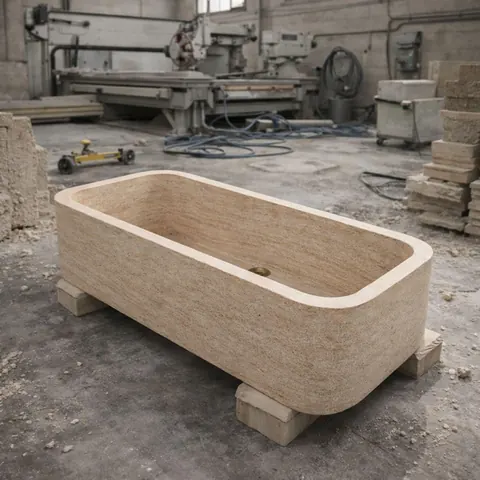
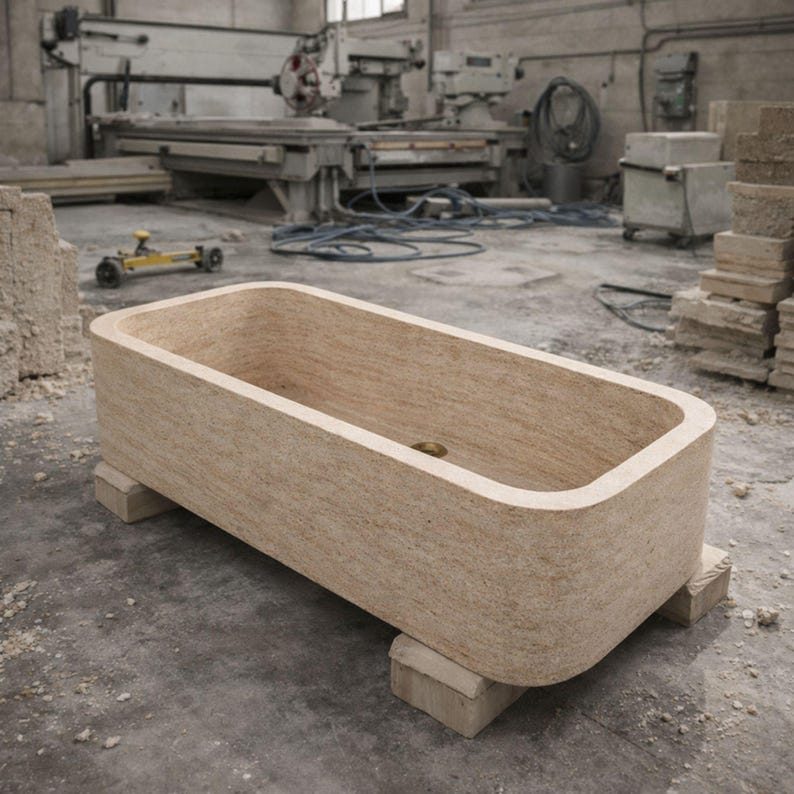
MarbleSinkCo lists one bathtub: a travertine soaking tub 63 x 31.5 x 23.6 in (160 x 80 x 60 cm), carved by hand from a single block, at $18,308. It is ordered through the Etsy shop at https://marblesinkco.etsy.com. Other sizes and stones are quoted on request. Size, price and key facts are on the stone bathtubs page, and the marble bathtub buying guide covers stone choice and interior sizing.
Frequently Asked Questions
Is a stone bathtub better than acrylic or cast iron?+
A stone bathtub is better only for a specific kind of bathroom: one on a concrete slab or an engineer-approved floor, with a clear delivery route and an owner who accepts stone care rules. Acrylic is the practical choice for most bathrooms because it is light and costs $500 to $2,500. Enamelled cast iron, at $1,500 to $5,000, sits in the middle on weight and price.
Which bathtub material holds heat longest?+
Enamelled cast iron and solid stone both store a lot of heat and keep a bath warm for a long soak once the tub itself is warm. Both feel cold at first and take heat from the first water. Acrylic has little mass to store heat. We have not found an independent lab test that ranks the three.
How much heavier is a stone bathtub than a cast iron bathtub?+
A carved stone bathtub usually weighs far more than a cast iron one. Kohler lists a 66 in enamelled cast iron tub at 396 lb (180 kg). A stone tub with 0.3 m³ of travertine weighs about 1,524 lb (692 kg) at the ASTM minimum density of 144 lb per cubic foot. Always ask the seller for the weight of the specific tub.
Is a stone bathtub worth the cost?+
A stone bathtub is worth the cost for a bathroom designed around the tub, in a house you intend to keep, on a floor a structural engineer has cleared. For a quick refit, a rental, or an upper floor that cannot be reinforced, acrylic or cast iron is the sensible choice. A made-to-order stone tub cannot be returned.
Do stone bathtubs scratch or etch?+
Marble and travertine can scratch, and acids leave dull etch marks on them. A carved stone tub has no coating, so the material is the same all the way through and marks can be re-honed by a stone restorer. An acrylic tub is a moulded shell and a cast iron tub carries an enamel coating, so follow the maker's care instructions for those.
Is stone resin the same as a stone bathtub?+
No. A stone resin or solid surface tub is ground mineral bound in resin and cast in a mould. Stone resin tubs cost about $2,000 to $8,000, weigh far less than carved stone and are uniform in colour. A natural stone bathtub is carved from a single block of quarried stone, so every tub differs and the weight is much higher.
Which bathtub needs the most care?+
A marble or travertine bathtub needs the most care of the three. It needs a neutral cleaner or stone soap, and vinegar, limescale removers and scouring powders must be kept away from it. A stone tub should also be wiped dry after each bath and resealed when water stops beading. For acrylic and enamelled cast iron, follow the maker's care instructions.
Share this article