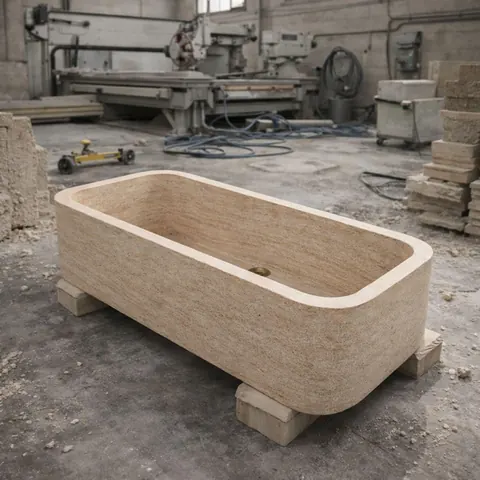
Short answer
Clean a travertine or marble bathtub with a neutral cleaner, stone soap or a little mild dish detergent in warm water, then rinse well and dry with a soft cloth. Wipe or squeegee the tub after every bath. Never use vinegar, lemon, limescale remover or scouring powder: acids etch calcium carbonate stone and abrasives scratch it. Remove soap scum with a non-acidic remover, and reseal with an impregnating sealer when water stops beading.
- Use a neutral cleaner, stone soap or mild dish detergent in warm water. Rinse and dry.
- Wipe or squeegee the tub after each bath to keep soap scum from building up.
- Never use vinegar, lemon, limescale remover, scouring powder or toilet bowl cleaner on stone.
- Travertine, marble, limestone and onyx are calcareous stones that etch on contact with acids.
- A sealer makes stone more resistant to stains. It does not make stone stain-proof or stop etching.
- An etch mark is surface damage, not a stain. A stone restorer can re-hone or repolish it.
Where to buy: MarbleSinkCo pieces are made to order and sold only through the MarbleSinkCo Etsy shop, marblesinkco.etsy.com.
A travertine or marble bathtub is easy to keep clean if two rules are followed: dry it after use and keep acids off it. This guide gives the routine, the products to avoid, and the fixes for soap scum, stains and etch marks. The cleaning advice follows the published guidance of the Natural Stone Institute and of the Marble Institute of America, which is now part of it.
How do you clean a travertine bathtub?
Clean a travertine bathtub with a neutral cleaner, stone soap or a little mild dish detergent in warm water, then rinse thoroughly and dry with a soft cloth. After every bath, rinse the tub with clean water and wipe or squeegee it. Never use vinegar, lemon, limescale remover or scouring powder on travertine.
The cleaners come from the Natural Stone Institute’s care guidance, which recommends “a neutral cleaner, stone soap, or a mild liquid dishwashing detergent and warm water”. The same page warns that too much cleaner or soap can leave a film and cause streaks, so use a small amount and rinse well.
| When | What to do |
|---|---|
| After each bath | Rinse with clean water. Wipe or squeegee the tub dry. |
| Weekly, or when the tub looks dull | Wash with a neutral cleaner or stone soap in warm water, using a soft cloth. Rinse and dry. |
| When soap scum builds up | Use a non-acidic soap scum remover. Rinse and dry. |
| When water stops beading | Clean, let the stone dry fully, and reseal with an impregnating sealer. |
| When a mark will not wash off | Work out whether it is a stain or an etch mark, then treat it as described below. |
The same routine applies to a marble bathtub. Marble and travertine are both calcium carbonate stones and react to cleaners in the same way.
What should you never use on a stone bathtub?
Never use acids or abrasives on a travertine or marble bathtub. That rules out vinegar, lemon juice, limescale removers, scouring powders and creams, and toilet bowl cleaners. Acids dissolve a little of the calcium carbonate surface and leave a dull etch mark, and abrasives scratch the finish.
| Do not use | Why |
|---|---|
| Vinegar, lemon and other acidic cleaners | May dull or etch calcareous stones such as marble, travertine, limestone and onyx |
| Limescale removers | They are acids, so they etch the stone they are meant to clean |
| Scouring powders and creams | Often contain abrasives that may scratch the stone |
| Rust removers and toilet bowl cleaners | Some contain traces of hydrofluoric acid, which attacks all stones, including granite |
| Ammonia mixed with bleach | The mixture releases a toxic gas. Never combine them |
| General bathroom sprays | May contain acids or abrasives. Use one only if the label says it is safe for natural stone |
The rows on acidic cleaners, scouring powders, hydrofluoric acid and ammonia with bleach are taken from the Natural Stone Institute’s care guidance. The Marble Institute of America’s brochure Care and Cleaning of Natural Stone lists limestone, marble, travertine and onyx as calcareous stones, and granite, slate, sandstone, quartzite and soapstone as siliceous stones. Siliceous stones resist most household acids, but both bodies still advise against acidic cleaners on them.
How do you remove soap scum from a stone bathtub?
Remove soap scum from a stone bathtub with a non-acidic soap scum remover, or with a solution of about half a cup of ammonia in a gallon of water. The Natural Stone Institute gives both methods and adds that frequent or heavy use of ammonia may dull the surface of some stones. Rinse well afterwards and dry the tub.
Prevention is easier than removal. The Institute notes that in baths and other wet areas, “soap scum can be minimized by using a squeegee after each use”. A soft cloth does the same job on the curved inside of a tub.
How do you remove stains from a marble or travertine bathtub?
Remove a stain from a marble or travertine bathtub by matching the cleaner to the type of stain. Oil-based stains are dissolved with a gentle detergent, organic stains are lifted with hydrogen peroxide, and mildew is treated with diluted ammonia, bleach or hydrogen peroxide. Test any treatment on a hidden spot first.
| Stain | Likely cause in a bathtub | Treatment given by the Marble Institute of America |
|---|---|---|
| Oil-based | Bath oil, body oil, cosmetics | Clean gently with household detergent, mineral spirits or acetone |
| Organic | Tea-coloured or plant-based bath products | 12% hydrogen peroxide with a few drops of ammonia |
| Biological | Mildew | Half a cup of ammonia, bleach or hydrogen peroxide in a gallon of water. Never mix bleach and ammonia |
| Metal | Rust from a can or a metal fitting | Must be removed with a poultice |
| Water spots and rings | Hard water left to dry | Buff with dry 0000 steel wool |
| Etch mark | Acidic cleaner or bath product | Not a stain. Needs refinishing or repolishing by a stone professional |
The treatments are taken from the Marble Institute of America’s care brochure linked above. Test each one on a hidden spot before using it on a visible part of the tub.
What is the difference between a stain and an etch mark?
A stain is a substance that has soaked into the stone, and an etch mark is damage to the surface itself. A stain usually looks darker than the stone around it. An etch mark looks dull and lighter, and it is most visible on a polished finish. Cleaning removes stains but cannot remove etch marks.
The Marble Institute of America’s brochure puts it this way: some materials “will etch the finish but not leave a stain”, and etched areas need refinishing or repolishing by a stone dealer or professional restorer. A honed finish makes light etching less visible than a polished finish does, which is one reason a honed interior suits a bathtub. The finish guide compares honed and polished stone.
Do you need to seal a stone bathtub?
Sealing a travertine or marble bathtub is worthwhile, but a sealer has limits. The Natural Stone Institute describes sealers as impregnators that act as repellents: sealing “does not make the stone stain proof, it makes it more resistant to staining”. A sealer does not stop acids from etching the surface.
- Ask the seller whether the tub was sealed before shipping, and with which product.
- Reseal when water stops beading on the surface and starts to darken the stone. Follow the interval given by the sealer’s maker.
- Clean the tub and let it dry completely before sealing, and let the sealer cure for the time on its label before the next bath.
- Use an impregnating sealer made for natural stone in wet areas.
The Institute also notes that many stones do not need sealing, so the seller’s advice for the specific stone comes first. Our posts on sealing natural stone sinks and travertine care cover sealing in more detail.
Which bath products are safe in a stone bathtub?
Plain water and mild soap are the lowest-risk products in a stone bathtub. Bath bombs, oils and strongly coloured products are the highest-risk, because some are acidic, some are oily and some are heavily dyed. No bath product needs to be banned if the tub is rinsed and wiped straight after the bath.
- Check the label of a new product for acids and dyes before using it in a stone tub.
- Rinse the tub with clean water as soon as it drains, then wipe it dry.
- Keep bottles and metal cans off the rim, where drips and rust rings mark the stone.
Is a granite or basalt bathtub easier to care for?
A granite bathtub is less sensitive to acids than a marble or travertine bathtub, because granite is a siliceous stone made mainly of silicates. Siliceous stones resist most household acids. The Natural Stone Institute still advises against acidic cleaners on them, because they can contain traces of acid-sensitive minerals.
| Stone family | Stones | Reaction to household acids |
|---|---|---|
| Calcareous | Marble, travertine, limestone, onyx | Etches. Use neutral cleaners only |
| Siliceous | Granite, slate, sandstone, quartzite, soapstone | Generally resistant, but acidic cleaners are still not recommended |
The routine in this guide is safe for both families. The MarbleSinkCo bathtub is travertine, a calcareous stone, so the neutral-cleaner rule applies to it in full. Size, price and key facts for that tub are on the stone bathtubs page, and the planning guide covers weight, floor checks and delivery.
Frequently asked questions
How do you clean a travertine bathtub?+
Clean a travertine bathtub with a neutral cleaner, stone soap or a little mild dish detergent in warm water. Wipe the surface with a soft cloth or sponge, rinse thoroughly and dry. After every bath, rinse the tub and wipe or squeegee it so soap scum does not build up. Never use vinegar, lemon, limescale remover or scouring powder on travertine.
Can you use vinegar or bleach on a marble bathtub?+
Do not use vinegar on a marble bathtub. Vinegar is an acid, and the Natural Stone Institute warns that products containing lemon, vinegar or other acids may dull or etch calcareous stones such as marble and travertine. Diluted bleach is listed by the Marble Institute of America only for removing mildew, at half a cup per gallon of water, and must never be mixed with ammonia.
How do you remove soap scum from a stone bathtub?+
Remove soap scum from a stone bathtub with a non-acidic soap scum remover, or with a solution of about half a cup of ammonia in a gallon of water. The Natural Stone Institute gives both methods and warns that frequent use of ammonia may dull some stones. Using a squeegee or cloth after each bath keeps soap scum to a minimum.
Do bath bombs and bath oils damage a stone bathtub?+
Bath bombs, oils and coloured salts can mark a stone bathtub if they sit on the surface. Oils can leave dark stains, dyes can tint the stone, and acidic products can etch marble and travertine. Check the label, rinse the tub with clean water straight after the bath and wipe it dry. Sealed stone resists staining better, but a sealer does not stop etching.
How often should a stone bathtub be sealed?+
Reseal a stone bathtub when water stops beading on the surface and starts to darken the stone, and follow the interval given by the sealer's maker. The Natural Stone Institute describes sealers as impregnators that make stone more resistant to staining, not stain-proof. Ask the seller whether your tub was sealed before shipping and with which product.
What is the difference between a stain and an etch mark on a stone tub?+
A stain is a substance absorbed into the stone, and it usually looks darker than the stone around it. An etch mark is a dull, lighter spot where acid has dissolved a little of the surface. Stains are drawn out with the right cleaner or a poultice. Etch marks have to be re-honed or repolished, usually by a stone restoration professional.
How do you remove hard water marks from a travertine bathtub?+
Do not use limescale remover on a travertine bathtub, because limescale removers are acids and etch the stone. For water spots and rings, the Marble Institute of America's care brochure advises buffing with dry 0000 steel wool. Test on a hidden spot first. Drying the tub after each bath prevents most hard water marks from forming.