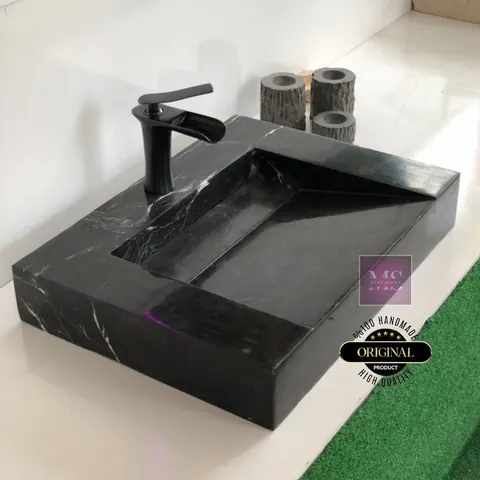
A Nero Marquina marble sink is carved from black marble with white calcite veins. It is a sound material for a bathroom sink, but limescale, soap film and acid etching all show up pale against the black. Plan to wipe it dry after use, clean it with a pH-neutral cleaner and reseal it about once a year.
If you have hard water and want a black sink that needs little attention, basalt or black granite is the easier choice.
What is Nero Marquina marble?
Nero Marquina is the trade name of a fine-grained black stone with irregular white veins. Geologically it is a dense limestone that takes a polish. The stone trade sells it as marble, and for a sink owner the label makes no practical difference.
What matters is the chemistry. Like every marble, it is calcium carbonate:
- Hardness is about 3 to 4 on the Mohs scale, so grit and metal can scratch it.
- Acids dissolve the surface. Vinegar, citrus and limescale removers leave dull marks called etching.
- The stone is dense, so a carved sink is much heavier than a ceramic one.
Blocks vary. Some are almost solid black with a few hairline veins, others carry thick white bands. Black marbles with similar veining are often sold under the same or a similar trade name, so ask the seller for photos of the actual piece.
Does black marble show water spots?
Yes. Black marble shows water spots, limescale and soap film more than white marble does, because all three dry to a pale grey or white. Stains from makeup, hair dye or rust are the opposite: they are mostly hidden on a black surface.
| Mark | What it is | How it looks on black marble | What to do |
|---|---|---|---|
| Water spots, limescale | Minerals left behind when hard water evaporates | White or grey rings, a crust around the drain and tap base | Wipe dry after use. Remove build-up with a non-acidic, stone-safe soap film remover |
| Soap film | Soap residue bound with minerals | A dull grey haze in the bowl | pH-neutral stone cleaner, rinse, dry |
| Etching | Acid has dissolved the surface | A dull, lighter patch that does not wipe off | Marble polishing powder for light marks on a polished finish, a stone restorer for deeper ones |
| Scratches | Grit or metal dragged across the stone | Fine grey lines | Light ones can be honed out by a restorer |
| Oil and cosmetic stains | Liquid absorbed into the pores | Rarely visible on black | Keep the stone sealed |
The useful test: a water spot sits on the surface and can be lifted, while an etch mark is damage to the surface itself. Scrubbing an etch mark with a stronger cleaner makes it worse.
Honed or polished: which finish suits a black marble sink?
A honed finish is the practical choice for the inside of a bowl. A polished finish gives the deepest black, but it is the least forgiving.
- Polished: mirror surface, strongest contrast between black and white. Every etch mark and dried drop shows as a matt patch on the gloss.
- Honed: smooth and matt, closer to charcoal than jet black. Etching blends in far better. Oily fingerprints can show as darker marks, and they wash off.
Some makers polish the outside and hone the inside. A colour-enhancing penetrating sealer deepens the black of a honed surface, so test it on the underside first. Our honed vs polished finish guide compares finishes in more detail.
How does hard water affect a black marble sink?
Hard water is the main reason owners regret a black marble sink. The US Geological Survey classes water as follows:
| Hardness (mg/L as calcium carbonate) | Class | What to expect on black marble |
|---|---|---|
| 0 to 60 | Soft | Occasional spots, easy to keep clean |
| 61 to 120 | Moderately hard | Spots if the bowl is left to air dry |
| 121 to 180 | Hard | Visible rings within days unless the sink is dried after use |
| Over 180 | Very hard | Daily drying is required, and scale builds at the drain and tap base |
Your water supplier’s annual quality report lists hardness. One grain per gallon equals about 17 mg/L. In a hard-water home you have three realistic options: dry the sink every time, fit a water softener, or choose a stone that tolerates descaling.
How do you care for a black marble sink day to day?
- After each use: rinse the bowl and wipe it dry with a microfiber cloth. This one habit prevents most water spots.
- Weekly: wash with a pH-neutral stone cleaner or a drop of mild dish soap in warm water, rinse well and dry. Leftover soap is what turns into grey film.
- Keep products off the stone: put soap, perfume and cleaning bottles on a tray. Wipe toothpaste, mouthwash and cosmetics away when they land.
- Monthly: check the drain rim and the base of the tap for scale. Loosen it with a non-acidic, stone-safe soap film remover and a soft nylon pad or plastic scraper.
- Yearly: put a few drops of water on the stone. If it darkens instead of beading, apply a penetrating sealer as described in our sealing guide.
Never use vinegar, lemon, bleach-based bathroom sprays, limescale removers, scouring powder or steel wool. A sealer slows staining. It does not prevent etching or limescale. The article on cleaners for marble sinks lists what is safe.
Which tap finishes and wall colours suit Nero Marquina?
| Tap finish | Effect with black marble | Practical note |
|---|---|---|
| Brushed brass or gold | Warm contrast, a frequent pairing | Brushed surfaces hide fingerprints |
| Polished chrome or nickel | Cool, picks up the white veins | Shows water spots as readily as the stone |
| Matte black | Tone on tone, the veining becomes the only pattern | Limescale shows white on black taps too |
| Brushed nickel or stainless | Neutral and quiet | Easiest to keep looking clean |
For walls, white and warm off-white give the strongest contrast and make the veining read clearly. Plaster tones, sage and deep green soften it. Charcoal or black walls work only with good lighting at the mirror, because a black bowl against a dark wall loses its outline. Pale oak, walnut or a white marble countertop under a black vessel sink keeps the sink visible. There are more pairings in our guide to faucets for marble sinks.
What are the alternatives to a black marble sink?
If you like the colour but not the upkeep, look at basalt and black granite. Both are silicate rocks, so household acids do not etch them the way they etch marble.
| Nero Marquina marble | Basalt | Black granite | |
|---|---|---|---|
| Rock type | Calcium-based (limestone sold as marble) | Volcanic, silicate | Igneous, silicate |
| Mohs hardness | About 3 to 4 | About 6 | About 6 to 7 |
| Reaction to acids | Etches | Resistant | Resistant |
| Look | Black with white veins | Even dark grey to black, usually honed | Black, fine speckle, little or no veining |
| Shows limescale | Yes | Yes | Yes |
| Sealing | About once a year | Recommended | Recommended |
Limescale shows on any dark sink. The difference is that on basalt and granite it can be removed without the etching risk that marble carries. Neither has white veining, which is the reason most people choose Nero Marquina in the first place. You can compare both looks in the black marble and basalt sink collection.
How much does a Nero Marquina marble sink cost?
The price of a Nero Marquina marble sink rises with the size of the block and the amount of carving. Machine-made black marble bowls cost less than sinks carved by hand to order.
MarbleSinkCo sinks start at $727, and most cost $900 to $3,000. Each one is made to order in about 2 weeks and ships free by insured express courier. Orders are not returnable and there is no warranty, so confirm dimensions, drain position and finish before the stone is cut. Current designs are on the black marble vessel sinks page, and every piece is ordered through the MarbleSinkCo Etsy shop.
Budget separately for a faucet, a drain and installation. Most carved stone sinks have no overflow, so they need a drain made for sinks without one. A wall-mounted stone sink must be fixed into studs or solid blocking, never drywall anchors.
Frequently Asked Questions
What is Nero Marquina marble?+
Nero Marquina is the trade name of a fine-grained black stone with irregular white calcite veins. Geologically it is a dense limestone that takes a polish, and the stone trade sells it as marble. Nero Marquina is calcium-based, about 3 to 4 on the Mohs scale, and reacts with acids like any marble, so vinegar and limescale removers etch it.
Does black marble show water spots?+
Yes, more than white marble. Hard water leaves pale mineral deposits when it dries, and they stand out against a black surface. Soap film and acid etching also look grey or dull on black stone. Wiping the sink dry after use prevents most spotting, and a penetrating sealer helps with stains but does not stop limescale or etching.
Is black marble good for a bathroom sink?+
It works well if you accept a short daily routine. Black marble hides makeup, hair dye and rust stains better than white marble, but it shows limescale, soap film and etch marks more clearly. In a soft-water home with a honed finish it is easy to live with. In a hard-water home, basalt or black granite needs less attention.
How do you clean a black marble sink?+
Rinse and wipe the bowl dry with a microfiber cloth after use, and wash it weekly with a pH-neutral stone cleaner. Never use vinegar, citrus cleaners, limescale removers or abrasive powders, because acids dissolve the surface and leave dull marks. Reseal with a penetrating sealer about once a year, or when water stops beading.
Should a black marble sink be honed or polished?+
Polished Nero Marquina gives the deepest black and the sharpest white veins, but every etch mark shows as a dull patch on the mirror surface. A honed finish is softer and more charcoal in colour, and it hides etching far better, although it can show oily fingerprints. For a bowl that sees water every day, honed is the more forgiving choice.
How much does a Nero Marquina marble sink cost?+
Price depends on the size of the block and how much stone is carved away. Machine-made black marble bowls cost less than hand-carved ones. MarbleSinkCo hand-carved sinks start at $727 in the smallest size, and most cost $900 to $3,000, with free shipping. Add the cost of a faucet, a drain without overflow, and installation, which varies by region and sink type.
Share this article