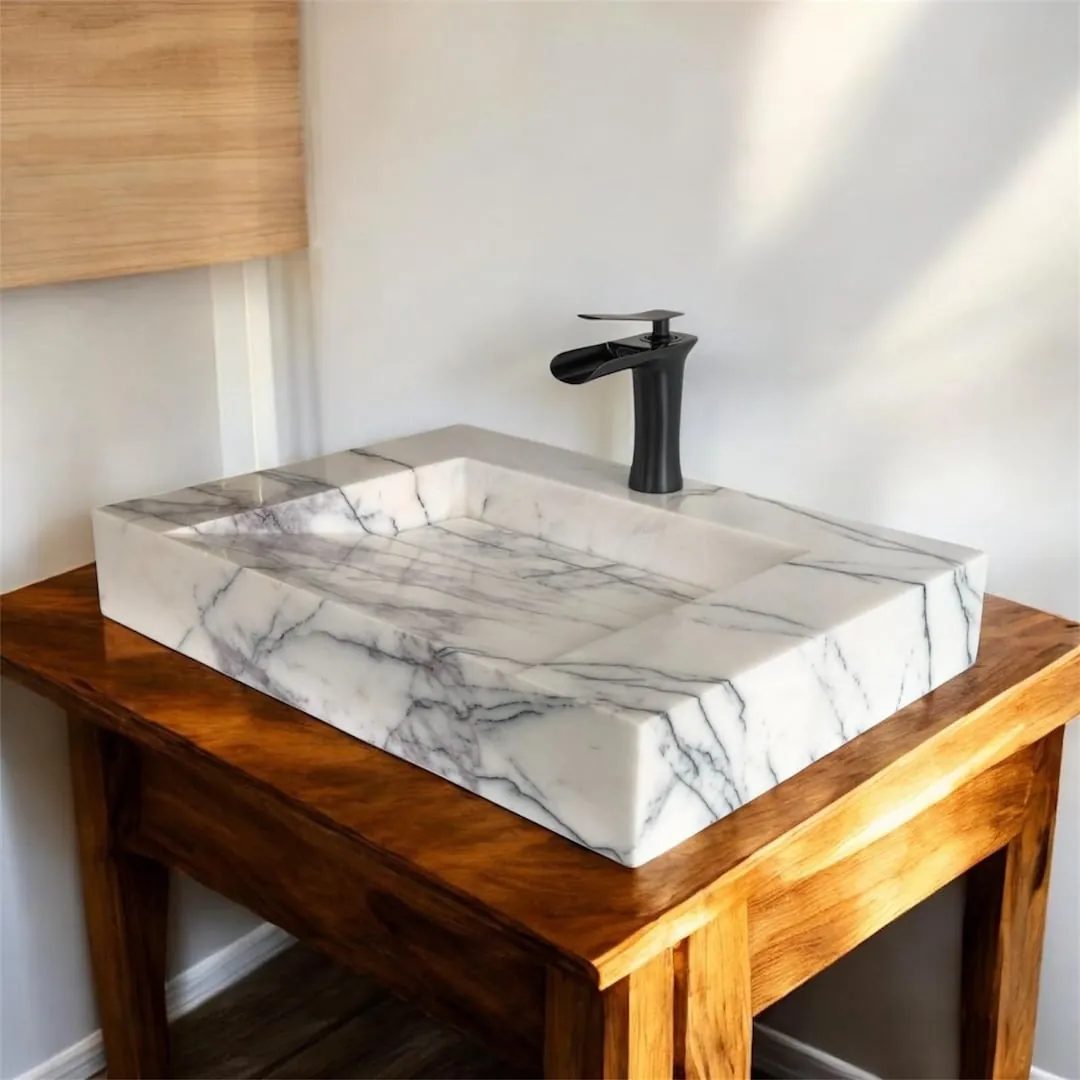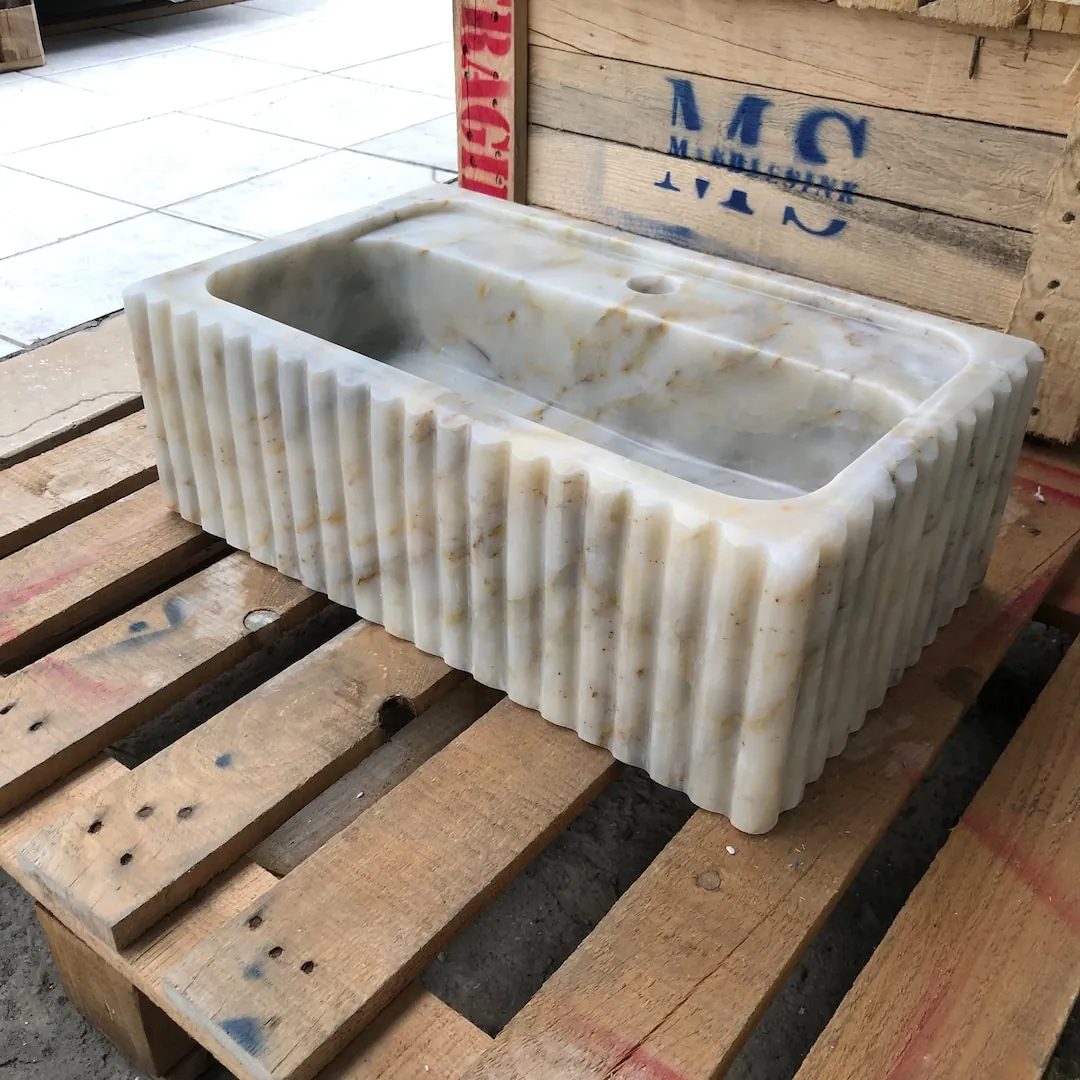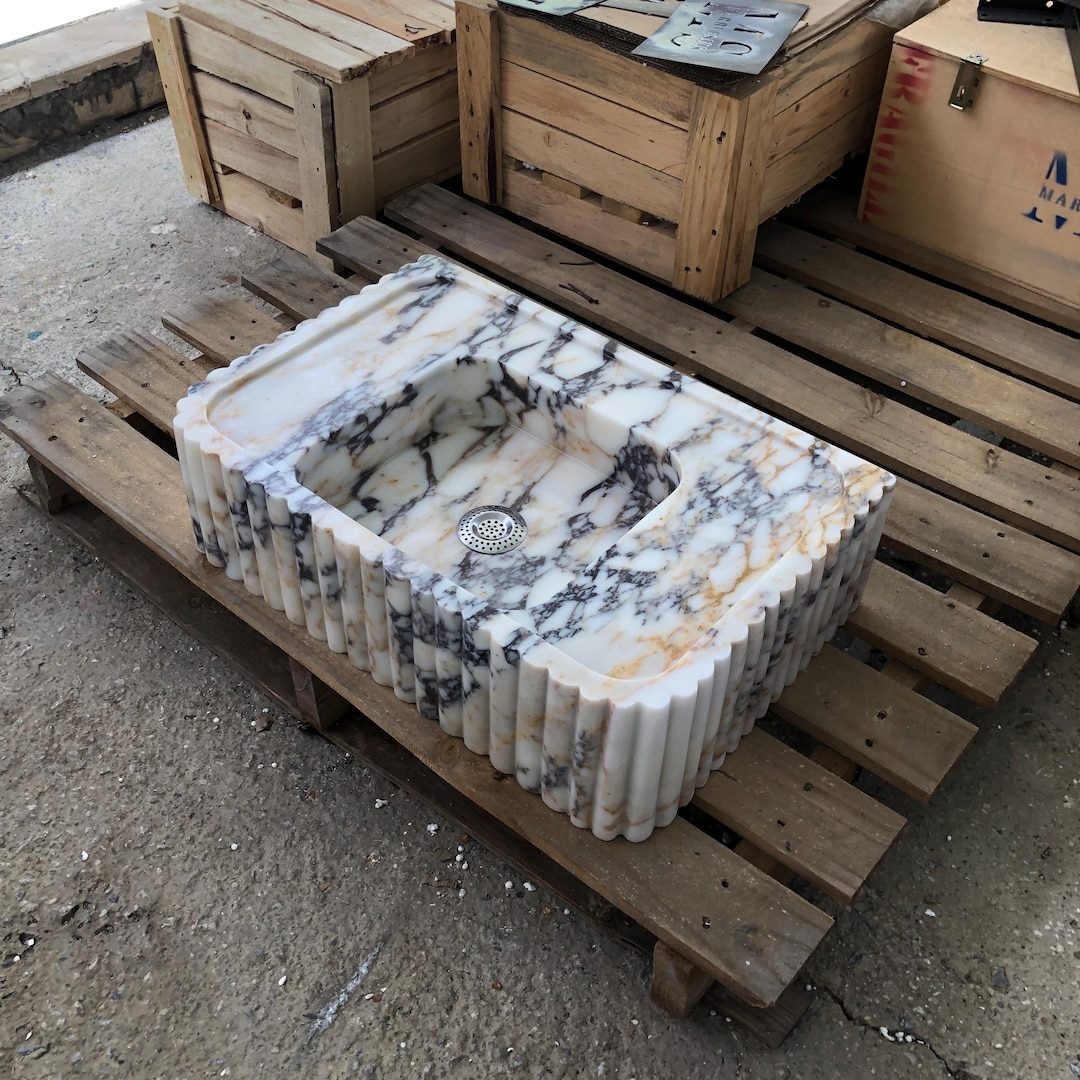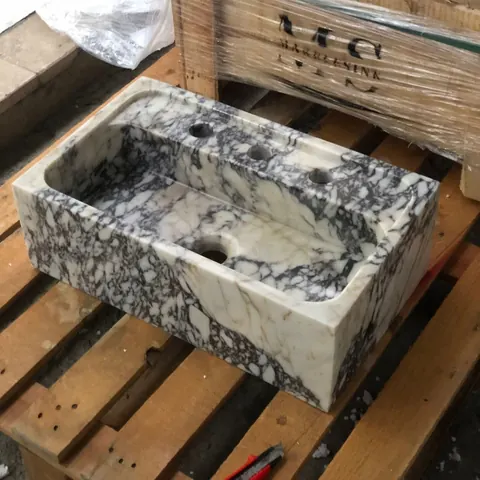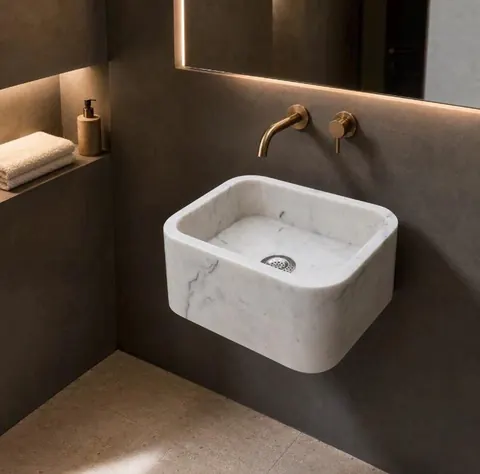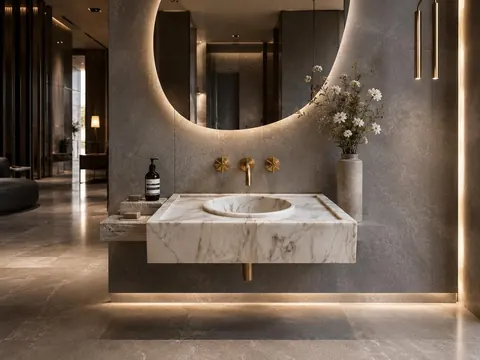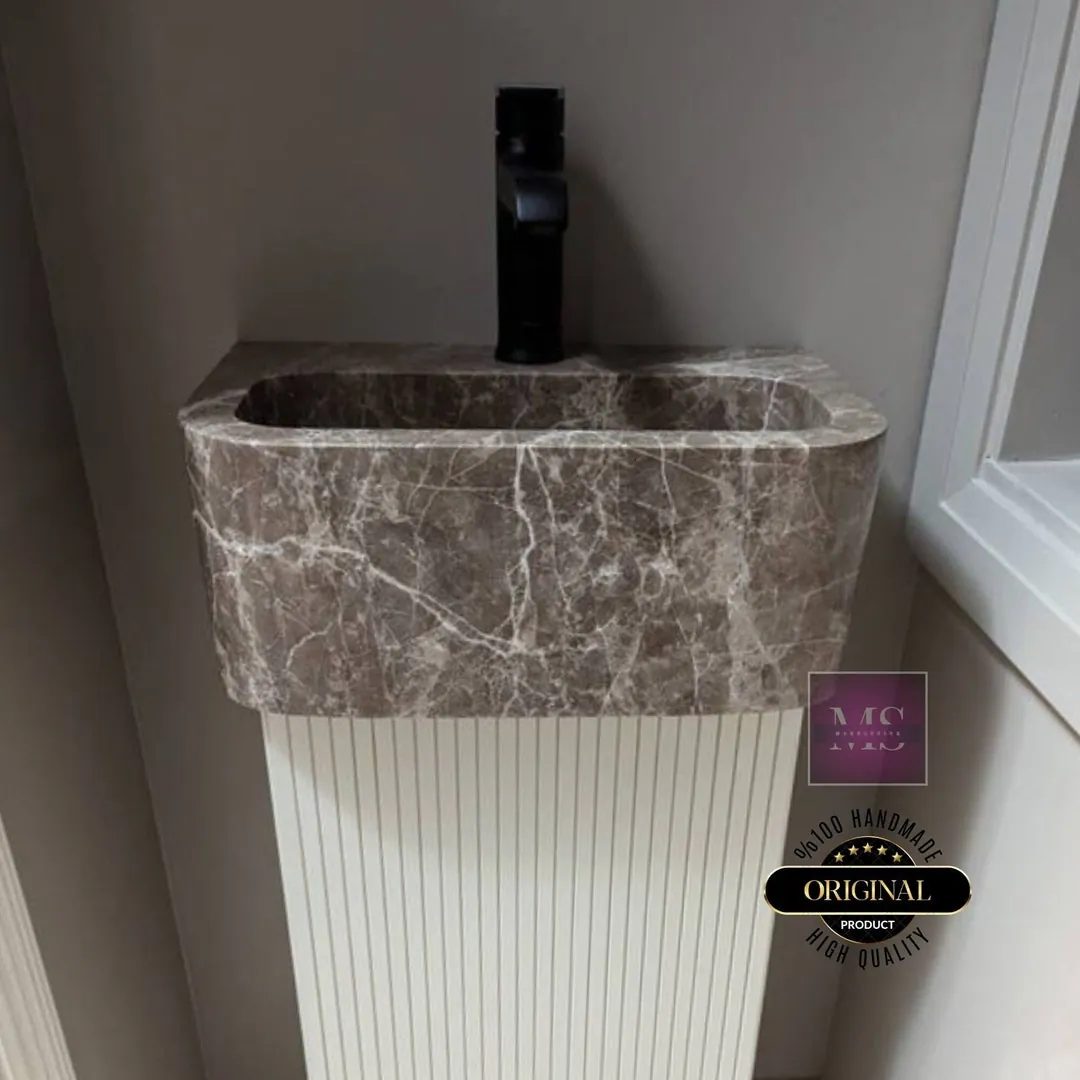
An oval marble sink is typically 16 to 24 in (405 to 610 mm) wide, 12 to 16 in (305 to 405 mm) front to back and, as a vessel, 4 to 6 in (100 to 150 mm) high. Set long side parallel to the counter edge, it gives more hand room than a round bowl on less counter depth.
Most fit a counter 18 to 22 in deep, with a tall or wall-mounted faucet behind the middle of the long side and a drain made for sinks without overflow.
What sizes do oval marble sinks come in?
An oval is described by two numbers, width (side to side) and depth (front to back). The depth decides whether it fits your counter. The table adds 5 to 6 in to the bowl depth for a deck faucet behind the bowl, or 2 to 3 in for a wall-mounted faucet.
| Outside size, width x depth | Counter depth, faucet behind bowl | Counter depth, wall-mounted faucet | Typical use |
|---|---|---|---|
| 16 x 12 in (405 x 305 mm) | 17 to 18 in | 14 to 15 in | Powder room, narrow vanity |
| 18 x 13 in (455 x 330 mm) | 18 to 19 in | 15 to 16 in | Small bathroom |
| 20 x 14 in (510 x 355 mm) | 19 to 20 in | 16 to 17 in | Everyday bathroom |
| 22 x 15 in (560 x 380 mm) | 20 to 21 in | 17 to 18 in | Primary bathroom |
| 24 x 16 in (610 x 405 mm) | 21 to 22 in | 18 to 19 in | Large vanity, standard 22 in top |
These are typical sizes, not standards. Carved stone walls are often 3/4 to 1-1/4 in (20 to 30 mm) thick, so a 20 x 14 in oval is about 17.5 to 18.5 in by 11.5 to 12.5 in inside. The marble sink dimensions and bowl size guide explains how to read sink measurements.
Why does an oval give more washing width for less counter depth?
A round bowl needs as much counter depth as it has width. An oval separates the two, so the width can grow while the depth stays small.
| Bowl | Width | Counter depth used | Outside footprint |
|---|---|---|---|
| Round, 16 in | 16 in | 16 in | About 201 sq in |
| Oval, 20 x 14 in | 20 in | 14 in | About 220 sq in |
| Round, 18 in | 18 in | 18 in | About 254 sq in |
| Oval, 22 x 15 in | 22 in | 15 in | About 259 sq in |
A 20 x 14 in oval is 4 in wider than a 16 in round bowl, covers about 10% more area, and still uses 2 in less depth. Hand washing and face washing use width more than depth, because two hands sit side by side. That is why an oval suits vanities under 20 in deep.
Which way should an oval sink face?
Set the long axis parallel to the front edge of the counter. This is the normal orientation, and it keeps the faucet close to the drain.
Turning the oval so the long axis runs front to back works only on a counter that is narrow but deep, such as a niche between two walls. In that position you reach further to the back of the bowl, and the drain sits further from a faucet on the back wall, so plan a wall-mounted spout with a long projection or a faucet beside the bowl.
Faucet position and spout reach for an oval basin
Put the faucet behind the middle of the long side. An oval vessel sink needs a tall deck-mounted vessel faucet or a wall-mounted faucet, and the position changes the reach it needs.
| Faucet position on a 20 x 14 in oval | Distance from rim to drain center | Result |
|---|---|---|
| Behind the middle of the long side | 7 in | Shortest reach. Stream lands on or just behind the drain |
| At the narrow end | 10 in | Too far for most deck faucets. Needs a long-reach spout |
Add the gap between the faucet center and the rim, usually about 2 in, to get the reach from the faucet hole. Many deck-mounted vessel faucets reach only about 4 to 6 in, so check the spec sheet. An oval needs less reach than a round bowl of similar capacity, because its drain is closer to the back rim.
For height, the spout outlet should sit at least 1 in above the rim, and 1 to 3 in suits most bowls. A 5 in bowl needs an outlet 6 to 8 in above the counter. A wall-mounted spout usually sits 3 to 6 in above the rim and projects about as far as the distance from the wall to the drain center. The full method is in the guide to choosing a faucet for a stone vessel sink.
How to measure for an oval sink
- Measure the counter depth from the front edge to the wall or backsplash.
- Subtract about 4 in for a deck faucet behind the bowl, or nothing for a wall-mounted faucet.
- Subtract 1 to 2 in so the bowl sits back from the front edge. The remainder is the largest bowl depth that fits.
- Measure the counter width and subtract a few inches on each side. The remainder is the largest bowl width.
- Subtract the bowl height from the rim height you want. Most adults are comfortable with a rim 32 to 36 in above the floor, so a 5 in bowl needs a counter at 27 to 31 in.
- Mark the drain at the bowl center and check that no drawer or rail sits under it.
Drain position and drain type
Oval basins normally have the drain in the center. The floor of an oval is longer and flatter than the floor of a round bowl, so look at photos or ask the maker whether it slopes to the drain from both ends. A flat floor holds a film of water at the ends.
Most carved stone basins have no overflow, so use a drain made for sinks without overflow. US bathroom drains have a 1-1/4 in tailpiece and usually fit a hole of about 1-3/4 in. Check that the threaded body is long enough for the stone plus the countertop, and seal the flange with non-staining silicone or a putty rated for stone. The stone sink drain guide compares drain types.
Splash and cleaning
Splash depends on the faucet match more than on the shape. Water splashes when it falls a long way or lands on the back slope of the bowl, so keep the spout outlet low, aim at the drain, and fit an aerator.
Marble is calcium-based and about 3 to 4 on the Mohs scale. Onyx is calcium-based too and reacts to acids the same way.
- Rinse after use and wipe dry with a soft cloth.
- Wash with a pH-neutral cleaner or mild dish soap.
- Keep vinegar, citrus cleaners and limescale removers off the stone. Acids etch it.
- Reseal with a penetrating sealer about once a year.
The stone sink care routine lists daily, weekly and yearly tasks.
Oval vs round vs rectangular bathroom sinks
| Shape | Typical outside size | Strength | Limit |
|---|---|---|---|
| Oval | 16 to 24 in wide, 12 to 16 in front to back | Wide bowl on a shallow counter. No corners. Short faucet reach | Needs more counter width than a round bowl |
| Round | 12 to 18 in diameter | Fits a narrow vanity, console or shelf | Needs as much depth as width |
| Rectangular | 16 to 24 in wide, 12 to 16 in front to back | Largest bowl for the footprint. Sits close to the wall | Inside corners take more cleaning |
For rooms where every inch counts, see the comparison of stone sinks for small bathrooms.
How much does an oval stone sink cost?
MarbleSinkCo’s two oval designs are listed from $1,058 and $1,104. Across the shop’s own listings, sinks start at $727 and most cost $900 to $3,000. The median price is $1,242 for sizes up to 16 in wide, $1,532 for 17 to 20 in and $1,831 for 21 to 24 in, according to the stone sink price index. Factory-made stone bowls from large retailers usually cost less than hand-carved, made-to-order pieces. A vessel or wall-mounted faucet, a drain without overflow and plumber labor are extra.
Oval sinks in the MarbleSinkCo catalogue
Oval basins are a small part of the range. Of about 230 designs, two listings are described as oval in their titles.
| Design | Type | Price |
|---|---|---|
| Calacatta Viola Marble Sink, Oval Bathroom Washbasin | Vessel | From $1,058 |
| Onyx Marble Vessel Sink, Oval Bathroom Vanity Top | Vessel | From $1,104 |
Each sink is carved to order in about 2 weeks, and custom sizes, drain positions and tap holes can be requested before the stone is cut. To see other basin forms, browse the vessel sink collection or filter by size, stone and price in the sink finder. Orders go through the MarbleSinkCo Etsy shop.
Comparing shapes? See the guides to round marble sinks, rectangular marble sinks and square marble sinks.
Frequently Asked Questions
What size is an oval marble sink?+
Oval marble sinks typically run from 16 x 12 in (405 x 305 mm) to 24 x 16 in (610 x 405 mm), measured across the outside. Vessel versions are usually 4 to 6 in high. About 20 x 14 in is a common everyday size. Stone walls are thick, so the inside of the bowl is about 1.5 to 2.5 in smaller each way.
Is an oval sink better than a round sink?+
For a shallow counter, usually yes. A 20 x 14 in oval is 4 in wider than a 16 in round bowl and uses 2 in less counter depth, with a slightly larger footprint overall. A round bowl is the better fit where the counter is short from side to side, such as a narrow vanity, console or shelf.
Which way should an oval vessel sink face?+
Set the long axis parallel to the front edge of the counter. That puts the width where your hands move and keeps the faucet close to the drain. Turn the oval front to back only on a counter that is narrow but deep, and plan a wall-mounted or long-reach faucet, because the drain then sits further from the back.
Where does the faucet go on an oval vessel sink?+
Behind the middle of the long side, on the counter or the wall. From there the drain is only half the bowl depth away, about 7 in on a 20 x 14 in oval, plus the gap to the rim. A faucet at the narrow end is about 10 in plus the gap from the drain, which is too far for most deck faucets.
Do oval marble sinks fit a standard vanity?+
Yes. A standard US vanity top is about 22 in deep. An oval up to 16 in front to back fits on it with a deck faucet behind the bowl, and smaller ovals of 12 to 13 in fit narrow vanities of about 18 in. Check the width too: leave a few inches of counter on each side of the bowl.
How do you clean an oval marble sink?+
Rinse it after use, wipe it dry with a soft cloth, and wash it with a pH-neutral cleaner or mild dish soap. Marble is calcium-based, so vinegar, citrus cleaners and limescale removers etch it and leave dull marks. Reseal with a penetrating sealer about once a year. An oval has no inside corners, so there is nowhere for residue to collect.
Share this article