Short answer
A stone vessel sink is a bowl carved from solid marble, travertine or another stone that sits on top of a counter. Choose a bowl 4 to 6 in high, set the counter so the finished rim lands 32 to 36 in above the floor, pair it with a tall or wall-mounted faucet that reaches the drain, and use a drain made for sinks without overflow.
- Total rim height equals counter height plus bowl height; aim for 32 to 36 in.
- The counter needs one drain hole and must carry the weight of solid stone.
- Use a tall vessel faucet or a wall-mounted faucet whose stream lands near the drain.
- Stone vessel sinks usually have no overflow, so buy a non-overflow drain.
- Deeper bowls and gentler, aerated flow reduce splashing.
- Seal the stone and clean it with a pH-neutral product; avoid acids.
Where to buy: MarbleSinkCo pieces are made to order and sold only through the MarbleSinkCo Etsy shop, marblesinkco.etsy.com.
A stone vessel sink is one of the simplest ways to put natural stone in a bathroom. The bowl sits on the counter, the plumbing drops straight down, and the wall needs no special structure. The details still matter: rim height, faucet reach and the right drain decide whether the sink is comfortable to use. This guide covers each one.
What is a stone vessel sink?
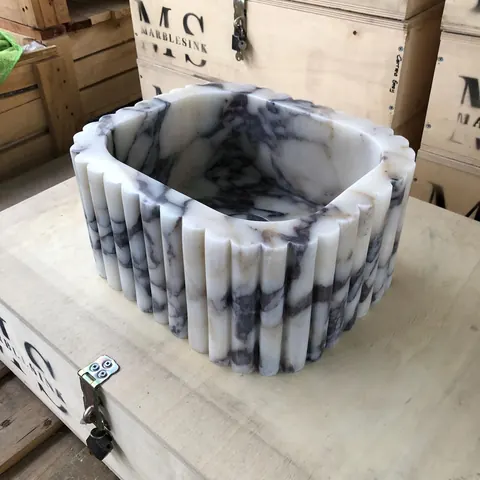
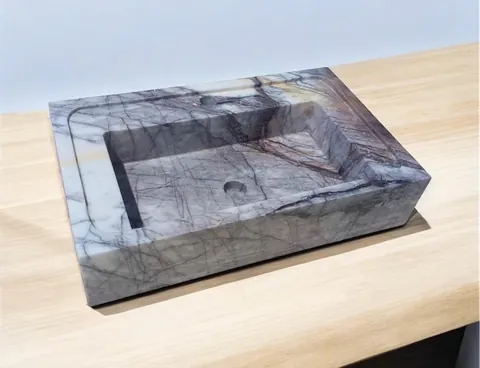
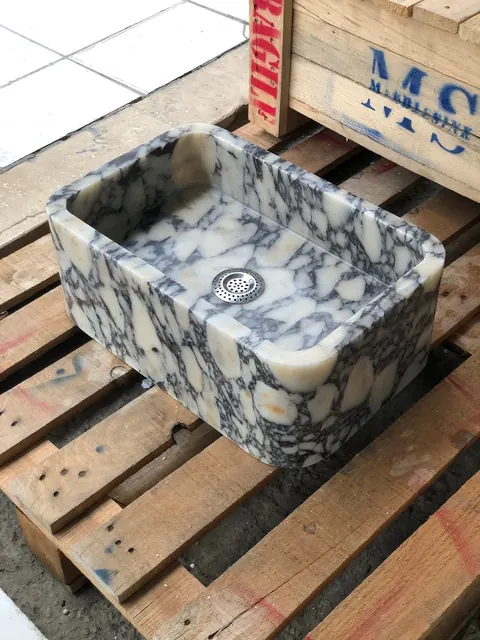
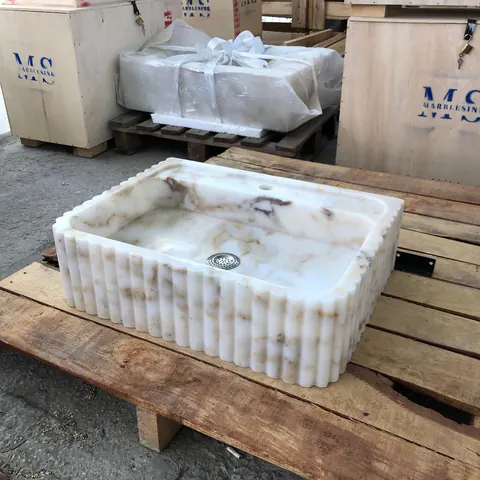
A vessel sink is a basin that sits on top of a counter instead of being dropped into it or mounted under it. A stone vessel sink is carved from one solid block of marble, travertine, onyx, basalt or another natural stone. People also call them stone sink bowls or above-counter basins.
Because the whole bowl is visible, both the inside and the outside are finished surfaces. The base is flat, with a single drain hole. Most carved stone bowls have no overflow and no faucet holes. The faucet goes on the counter or the wall.
You can see typical forms in the vessel sinks collection.
Stone sink bowl shapes: round, oval and rectangular
Shape affects how much counter the sink takes and how water behaves in the bowl.
| Shape | Common outside size | Best for | Watch for |
|---|---|---|---|
| Round | 14 to 18 in (355 to 455 mm) diameter | Powder rooms, narrow counters, traditional and organic styles | Needs counter depth equal to its full diameter plus faucet space |
| Oval | 16 to 22 in wide (405 to 560 mm) | Everyday bathrooms; more hand room across the width | Check which way the long axis runs on your counter |
| Rectangular | 16 to 24 in wide, 12 to 16 in front to back (405 to 610 by 305 to 405 mm) | Modern vanities, double sink runs, shallow counters | Flat floors need a good slope to the drain; inside corners take more cleaning |
These are common ranges, not rules. For help with sizing by room, see the marble sink dimensions and bowl size guide. For very small rooms, the small powder room marble sink guide covers compact options.
Vessel sink height: counter plus bowl
The most common vessel sink error is a rim that ends up too high. The rim height is the counter height plus the bowl height.
Most adults find a rim 32 to 36 in (815 to 915 mm) above the finished floor comfortable. Stone vessel bowls are often 4 to 6 in (100 to 150 mm) high. Work backward:
| Bowl height | Counter height for a 34 in rim | Counter height for a 36 in rim |
|---|---|---|
| 4 in (100 mm) | 30 in | 32 in |
| 5 in (125 mm) | 29 in | 31 in |
| 6 in (150 mm) | 28 in | 30 in |
A standard 36 in vanity with a 5 in bowl puts the rim at 41 in, which is too high for most people. Choose a lower vanity, or a floating vanity hung at the height you need. For an accessible bathroom, the rim should be no higher than 34 in (865 mm), with knee clearance below. Check your local code.
Counter and vanity requirements
A vessel sink asks three things of the counter.
Strength. Marble weighs roughly 160 to 170 lb per cubic foot. A stone bowl is much heavier than ceramic. A cabinet vanity with a stone, quartz or solid wood top carries it without difficulty. A floating vanity or shelf must be fixed to wall framing or blocking and built for the load. Ask the seller for the weight of the specific bowl.
A single drain hole. The counter needs one hole under the bowl’s drain, sized to pass the drain body. If the faucet mounts on the counter, it needs its own hole, commonly about 1-3/8 in (35 mm). Take both sizes from the drain and faucet spec sheets. Have the counter drilled after you have the bowl, so the holes match the real piece.
A flat, water-resistant surface. Water runs down the outside of a vessel bowl and collects at the base. Wood tops need a durable waterproof finish. Set the bowl on a thin bead of neutral-cure silicone to seal the joint.
Faucets and drains for a stone vessel sink
Faucet: tall or wall-mounted
A standard short bathroom faucet will not clear the rim. You have two choices.
- Tall vessel faucet on the counter. The spout outlet must sit above the rim with enough room for your hands. Mount it behind or beside the bowl.
- Wall-mounted faucet. It keeps the counter clear and suits wide bowls. The valve is set inside the wall, so the height must be fixed from the finished rim before the wall is closed.
In both cases, check spout reach. The stream should land at or just beside the drain, not on the near slope of the bowl and not on the rim. Measure from the faucet hole or wall to the drain center and compare it with the reach on the faucet’s spec sheet.
Drain: no overflow
A carved stone bowl normally has no overflow channel. Buy a drain made for sinks without overflow. A drain built for overflow sinks has openings in its body that can leak below a solid bowl.
Standard US bathroom sink drains have a 1-1/4 in tailpiece and usually fit a hole of about 1-3/4 in (45 mm). The trap is 1-1/4 or 1-1/2 in. Two points are specific to stone:
- The stone and the counter together are thick. Check that the drain’s threaded body is long enough for both.
- Oil-based plumber’s putty can stain natural stone. Use silicone or a stain-free putty rated for stone under the drain flange.
A press-to-close pop-up or an open grid drain both work. The guide to faucet holes, drain and plumbing for stone sinks goes further. Have a licensed plumber make the connections if you are not experienced.
Splash and bowl depth
Splash is the main complaint about vessel sinks, and it has three causes.
- A shallow bowl. Inner depths under about 4 in (100 mm) leave little wall to contain the water.
- A long fall. The higher the spout sits above the bowl floor, the harder the water hits.
- A hard stream. High flow without an aerator bounces off stone.
Choose a bowl with reasonable depth, set the spout only as high above the rim as your hands need, and use a faucet with an aerator. Aim the stream beside the drain, not onto a raised pop-up cap.
Marble, travertine or another stone?
- Carrara marble. White to gray with soft veining. It fits most bathrooms. See Carrara marble sinks.
- Calacatta and Calacatta Viola. Bolder veining for a bowl that is the focal point.
- Travertine. Warm beige tones with a naturally pitted texture, usually filled and honed. See travertine sinks.
- Nero Marquina and basalt. Dark stones. They hide stains but show soap film and water spots.
- Emperador and onyx. Brown tones, or translucent banding in the case of onyx.
Marble, travertine and onyx all etch with acids. The comparison of marble vs travertine bathroom sinks explains the differences. Honed hides water marks better than polished, as the finish guide explains.
Care. Seal the bowl inside and out with a penetrating stone sealer before first use, and reseal about every 6 to 12 months. Clean with a pH-neutral stone cleaner or mild soap. Keep vinegar, bleach and limescale removers away from the stone. Wipe the bowl and the joint at the base dry. The care FAQ has more.
Are stone vessel sinks practical? Pros and cons
| Pros | Cons |
|---|---|
| Simple installation on almost any solid counter | Rim sits higher, so the vanity must be lower |
| No wall blocking needed | Needs a tall or wall-mounted faucet |
| Easy to replace later without changing the counter | No overflow |
| The whole carved form is visible | The outside of the bowl and the base joint need cleaning |
| Solid stone can be re-honed if it marks | Stone needs sealing and etches with acids |
| Works on shallow or narrow counters | More splash if the faucet is poorly matched |
For a powder room or guest bath, a stone vessel sink is fully practical. A busy family bathroom needs a deeper bowl and a matched faucet.
MarbleSinkCo carves vessel sinks by hand from solid marble and travertine. Each is made to order in about 2 weeks, and custom sizes are available on request through the Etsy shop.
Common mistakes when buying a stone vessel sink
- Putting a vessel bowl on a standard 36 in vanity without checking the rim height.
- Buying the faucet before the bowl, then finding the spout too low or too short.
- Ordering a drain with overflow openings for a bowl without overflow.
- Drilling the counter from a drawing instead of from the actual bowl.
- Using oil-based plumber’s putty against the stone.
- Mounting a heavy bowl on a floating shelf that is not fixed to framing.
- Skipping the sealer, then cleaning with an acidic bathroom spray.
- Not asking about returns. Made-to-order stone usually cannot be returned, so measure first.
Frequently asked questions
Are stone vessel sinks practical?+
Yes, for bathrooms and powder rooms where the sink is used for hand washing, face washing and teeth. They are easy to install on an existing counter and easy to replace. They need more attention than porcelain: the stone must be sealed, acids avoided, and the joint around the base kept clean. A correctly matched faucet prevents most splashing.
How tall should a vanity be for a vessel sink?+
Work back from the rim. Most adults are comfortable with the finished rim 32 to 36 in above the floor. Subtract the height of the bowl to get the counter height. With a 5 in bowl, a counter about 29 to 31 in high puts the rim at 34 to 36 in. A standard 36 in vanity is usually too tall.
What kind of faucet do I need for a stone vessel sink?+
Use a tall vessel faucet mounted on the counter or a wall-mounted faucet. The spout outlet should sit above the rim with room for your hands, and the stream should land at or just beside the drain. Check the spout height and reach on the faucet's spec sheet against the height and width of your bowl.
Do stone vessel sinks have an overflow?+
Usually not. A carved stone bowl is a solid shell with no hidden overflow channel. Buy a drain made for sinks without overflow, with a 1-1/4 in tailpiece for a standard US bathroom trap. Because there is no overflow, do not leave the faucet running with the drain closed.
How do you attach a stone vessel sink to the counter?+
The bowl sits over the drain hole in the counter. A thin bead of neutral-cure silicone under the base stops it shifting and seals the joint, and the drain's locknut clamps the bowl to the counter from below. Avoid oil-based plumber's putty on natural stone, because it can stain. A licensed plumber should connect the trap.
Do marble vessel sinks stain or scratch?+
Marble can absorb colored liquids if it is not sealed, and acids leave dull etch marks. A penetrating stone sealer, reapplied about every 6 to 12 months, and a pH-neutral cleaner prevent most problems. Light wear can be honed out later, because the stone is solid all the way through.
How much does a stone vessel sink weigh?+
It depends on the size, wall thickness and stone. Marble weighs roughly 160 to 170 lb per cubic foot, so even a compact carved bowl is far heavier than a ceramic one. Ask the seller for the weight of the specific piece before ordering, and check that your vanity or floating shelf can carry it.