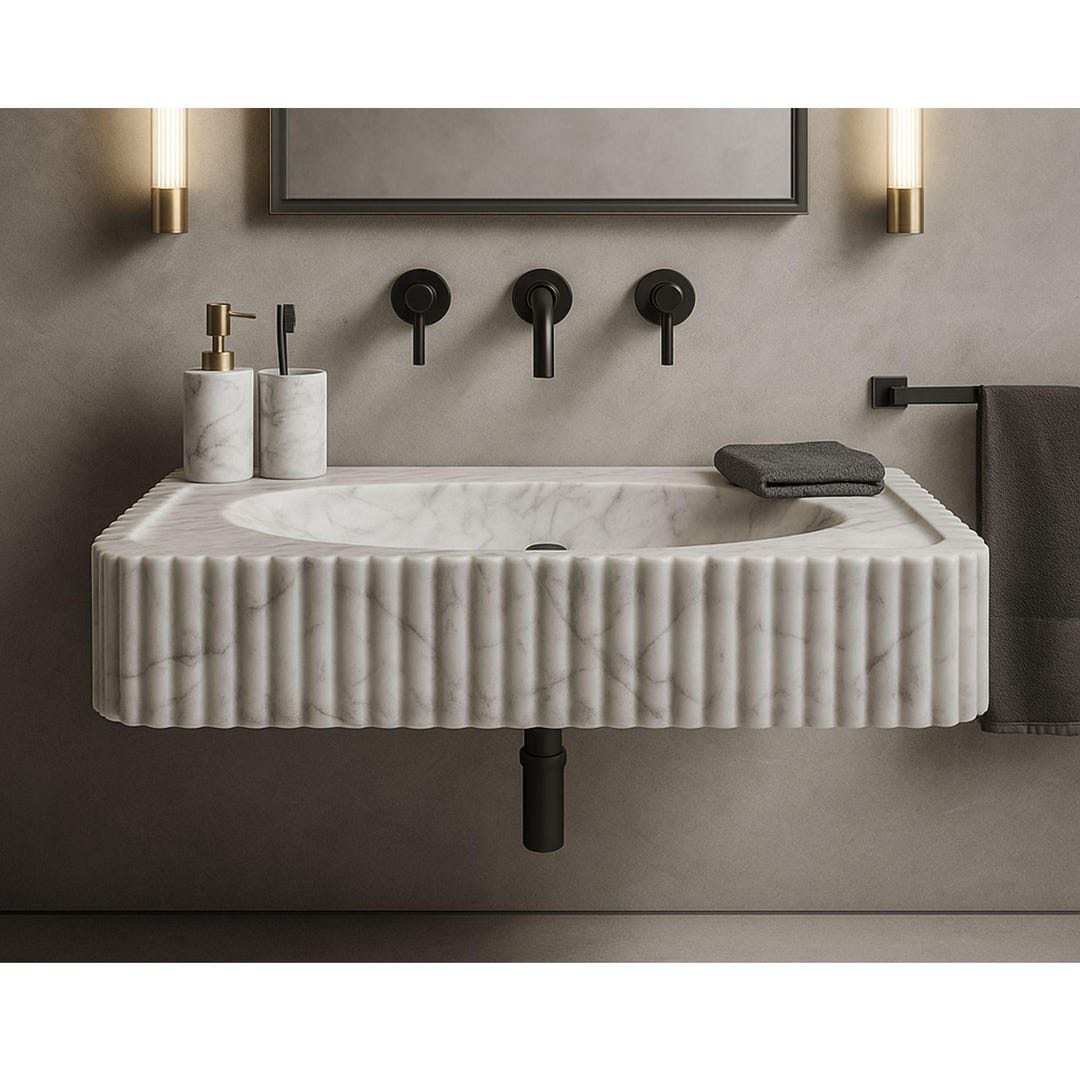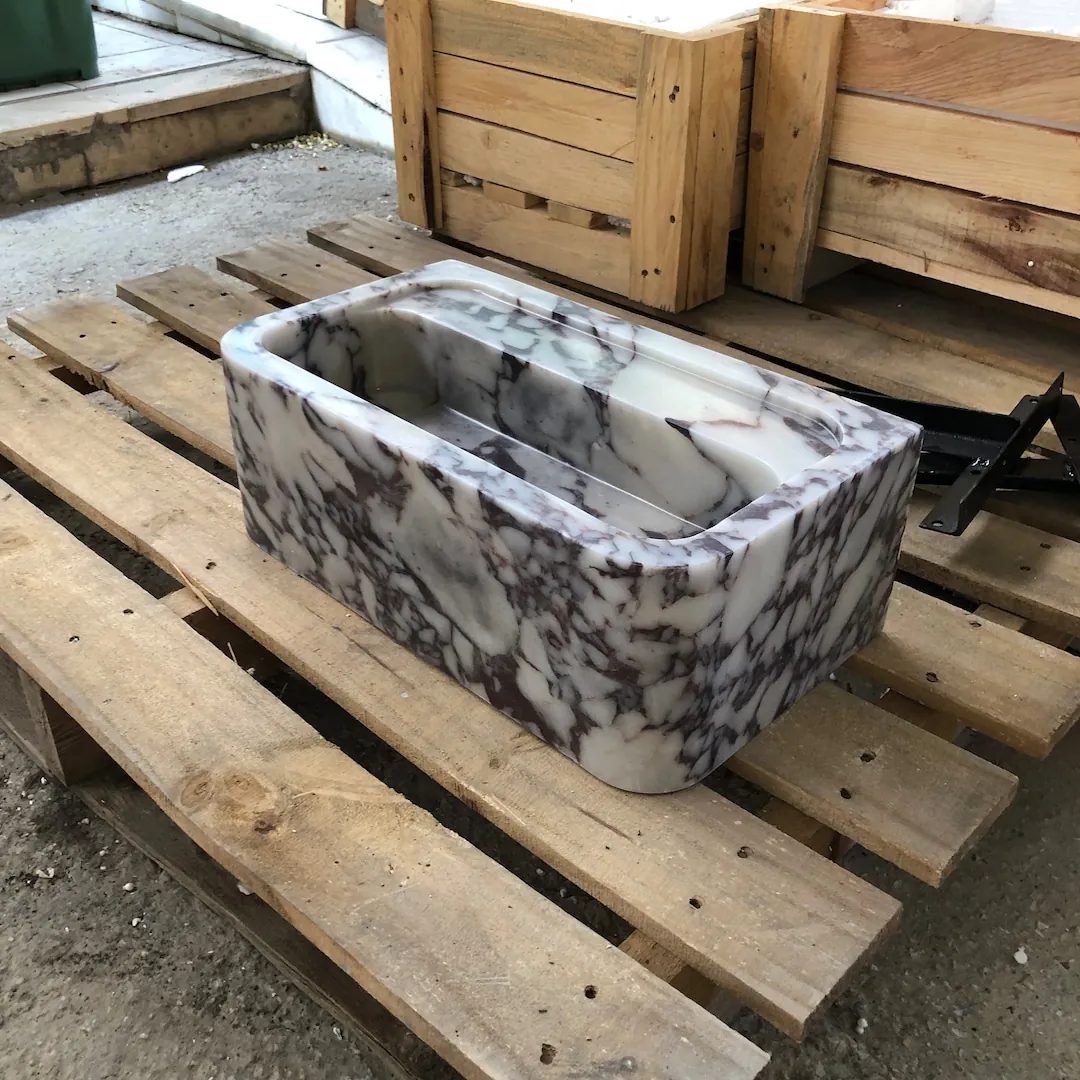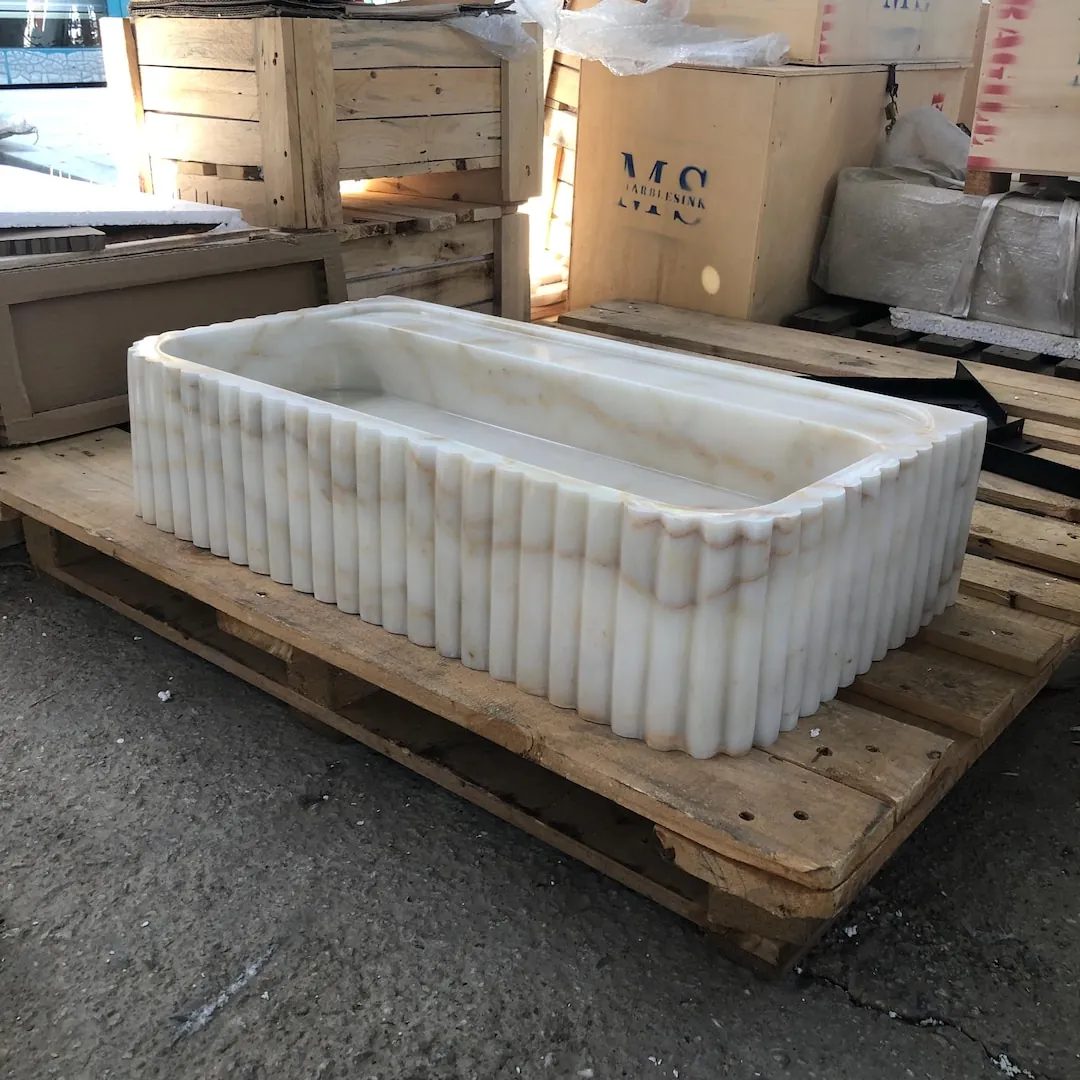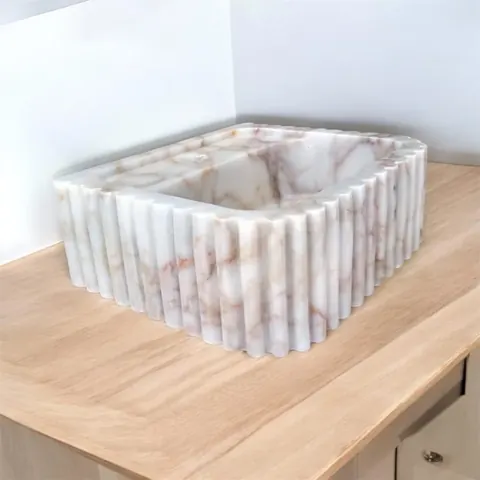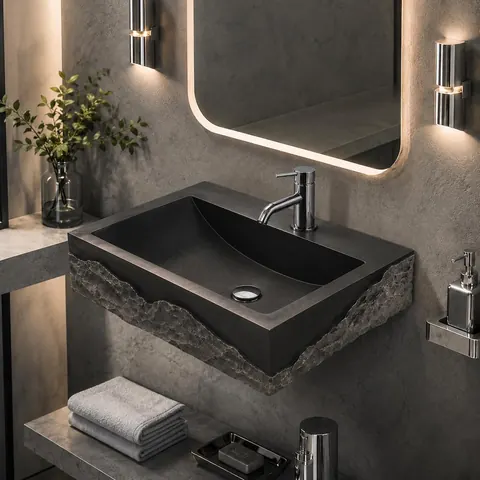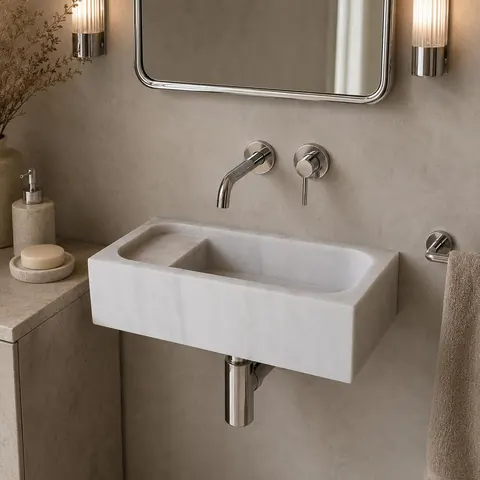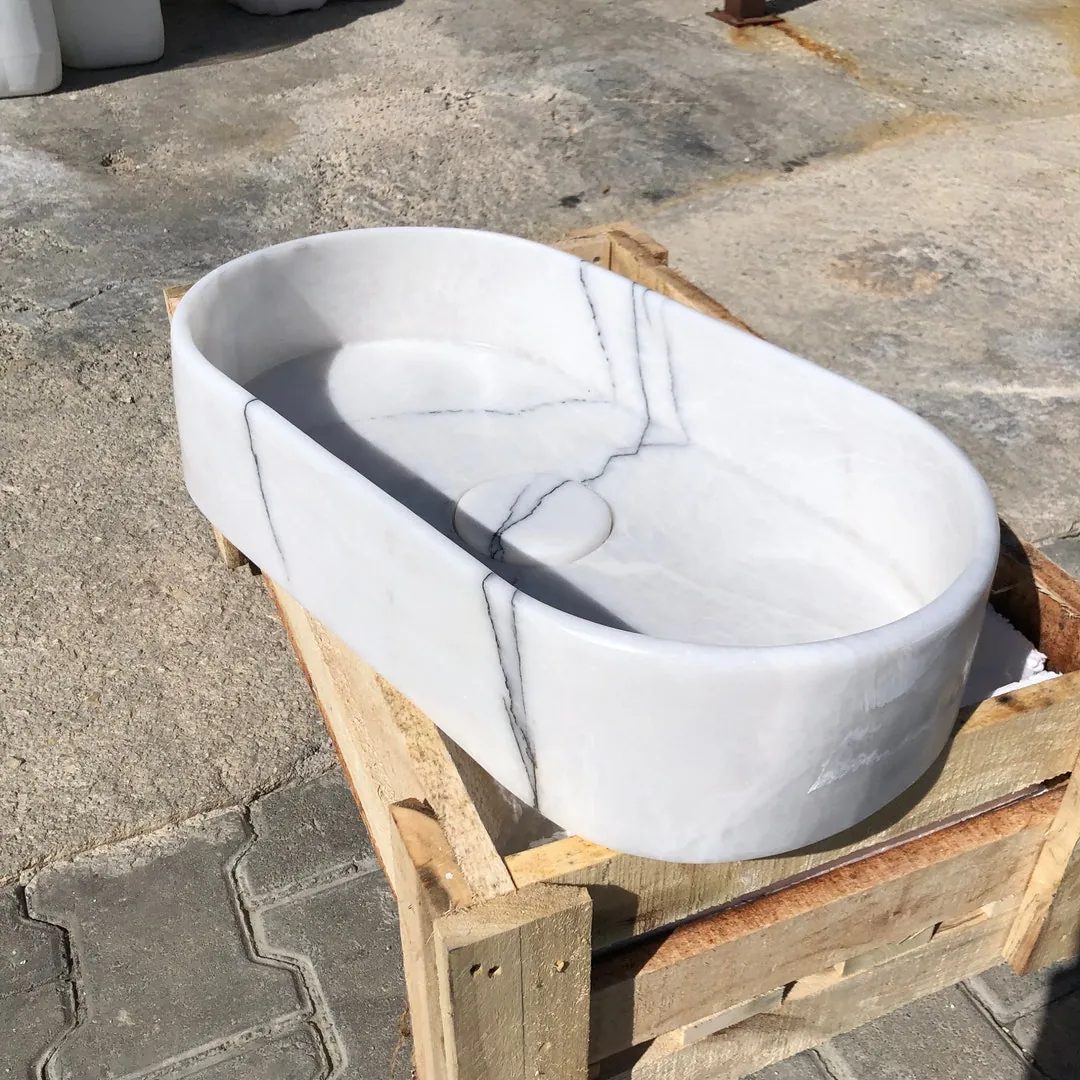
For a small bathroom, a wall-mounted sink is usually the better choice. It leaves the floor completely clear, can be hung at any height, and leaves knee space open for a seated user. A pedestal sink is better when you want the pipes screened or a traditional look. Neither gives you storage. The short, sourced answer is on wall-mounted sink vs pedestal sink.
How do wall-mounted and pedestal sinks compare?
| Wall-mounted sink | Pedestal sink | |
|---|---|---|
| Floor space | Floor fully clear under the basin | Column stands on the floor under the basin |
| Cleaning | Clear floor, easy to mop | Column on the floor |
| Plumbing | Trap and pipes in view unless a cover or decorative trap is used | Hidden behind the column |
| What carries the weight | Wall brackets or hanger bolts carry the full load | Wall bolts plus a column on the floor |
| Wall requirement | Solid backing, always | Solid backing for the basin bolts |
| Rim height | Set by where the brackets go | Fixed by the height of the pedestal |
| Knee space | Open under the basin | Taken by the column |
| Storage | None | None |
| Style | Open and minimal | Traditional |
Which saves more floor space?
A wall-mounted sink saves more, but the gain is smaller than it looks in photos. How far you can walk past a sink depends on how far the basin projects from the wall, and that is the same for both types at the same basin size. What the wall-mounted sink adds is clear floor underneath.
Two real differences matter in a tight room:
- Compact sizes. MarbleSinkCo lists 114 sink designs in a 12 in (30 cm) width, 7.9 to 12 in (20 to 30 cm) deep, from $727.
- Corners. A wall-hung corner basin fits a corner. MarbleSinkCo lists 4 corner sink designs, 10 to 23.6 in (25 to 60 cm) per side.
The International Plumbing Code minimums apply to both: 15 in (381 mm) from the sink centerline to a side wall and 21 in (533 mm) of clear floor in front (ICC). NKBA also suggests at least 4 in (10 cm) between the edge of a wall-hung or pedestal sink and a side wall. Codes are adopted and amended locally, so check with your inspector. For small layouts, see the powder room sink guide for small bathrooms.
Which is easier to clean?
The wall-mounted sink. The floor under it is open, so a mop passes straight through, and there is no joint between the fixture and the floor. A pedestal has a column standing on the floor under the basin.
Which hides the plumbing better?
A pedestal hides the trap and supply pipes behind its column, without a cabinet.
A wall-mounted sink leaves the trap and pipes in view unless a cover or a decorative trap is used, so the pipes become part of the design. The options are on P-trap or bottle trap for a wall-mounted stone sink.
What does each sink need from the wall?
Both sinks are fixed to the wall. The difference is how much the wall has to carry.
Wall-mounted. The wall takes the entire load. The brackets are fixed through the wall finish into solid blocking: typically 2x8 or 2x10 lumber, or 3/4 in (19 mm) plywood, fitted between the studs at bracket height before the wall is closed. Drywall, cement backer board and tile are finishes and cannot carry a sink. A stone basin is heavy, since marble is roughly 160 to 170 lb per cubic foot, and it rests on steel brackets. Masonry walls need anchors made for that material. The sequence is set out in the wall-mounted stone sink installation planning guide.
Pedestal. The column shares the support of the basin, but the basin is still bolted to the wall: maker instructions call for backing behind the finished wall and hanger bolts (Kohler pedestal lavatory installation guide).
A builder or installer should confirm the wall and fixings for the weight of the exact sink.
Which sink can meet ADA knee clearance?
A wall-mounted sink leaves the knee space open, and the column of a pedestal sink takes it. Where the ADA Standards apply, the U.S. Access Board guide calls for:
- Rim or counter surface no higher than 34 in (864 mm) above the floor
- Knee clearance at least 27 in (686 mm) high and 30 in (762 mm) wide under the sink
- Clear floor space of 30 by 48 in at the lavatory
- Pipes underneath insulated, enclosed or configured to prevent contact
The same numbers are a sound target for a bathroom planned for a wheelchair user. MarbleSinkCo sinks carry no accessibility certification, so the designer verifies the installed height and clearances. The bathroom sink height guide lists standard, comfort and accessible heights.
Which costs less, a wall-mounted or a pedestal sink?
We publish only our own prices, so compare current listings for the fixture and get local quotes for the labor. What differs between the two types is the extra work:
| Item | Wall-mounted | Pedestal |
|---|---|---|
| Trap | In view, so a cover or decorative trap is usual | Hidden behind the column |
| Wall backing | Required | Required |
| Opening a closed wall for blocking | Needed if there is no blocking | Needed if there is no backing for the bolts |
| Brackets | Steel brackets for a stone sink, sold separately | None; the basin is bolted to the wall |
For reference, MarbleSinkCo stone sinks start at $727 in the smallest size and most cost $900 to $3,000, with steel brackets sold separately from $138. MarbleSinkCo does not list a pedestal sink.
Which style suits which house?
A pedestal sink has a traditional look and suits a room where that look is wanted. A wall-mounted sink leaves the room more open, and in stone, with a wall-mounted faucet, it gives a plainer and more modern result.
Which is better, room by room?
| Room or situation | Better choice | Why |
|---|---|---|
| Narrow powder room | Wall-mounted | A clear floor and a rim height you choose |
| Corner installation | Wall-mounted | Wall-hung corner basins are listed |
| Traditional bathroom | Pedestal | The look, with the trap hidden |
| Accessible bathroom | Wall-mounted | Open knee space and a chosen rim height |
| Wall that cannot be opened and has no blocking | Not a wall-mounted stone sink | A wall-mounted stone sink needs blocking or masonry |
| Masonry or concrete wall | Wall-mounted | Brackets anchor into the wall with anchors made for masonry |
| Pipes you want out of sight | Pedestal | The column screens them |
| Main family bathroom | Neither | A vanity gives the storage both types lack |
How to decide in five checks
- Measure the clear floor in front of the sink position. The code minimum is 21 in, and NKBA recommends 30 in.
- Find out what is inside the wall. If blocking can be added, either type works. If not, a stone wall-mounted sink is off the list.
- Look at where the drain and supplies sit. Pipes you want hidden favor a pedestal.
- Decide who uses the room. A seated user, a child or a very tall adult favors a wall-mounted sink at a chosen height. NKBA gives 32 to 43 in (81 to 109 cm) as the adult range.
- Ask the maker for the weight of the sink and show it to whoever will fix it to the wall.
If the checks point to a wall-mounted basin in stone, the wall-mounted stone sink collection shows the shapes and sizes MarbleSinkCo carves by hand to order. MarbleSinkCo pieces are ordered through the MarbleSinkCo Etsy shop at https://marblesinkco.etsy.com, and the guide to stone sink weight and wall support helps you brief your installer.
Frequently Asked Questions
Is a wall-mounted or pedestal sink better for a small bathroom?+
A wall-mounted sink is usually better for a small bathroom. It leaves the floor completely clear and can be hung at any height. A pedestal sink suits a small room when you want the trap hidden behind a column or a traditional look. Both need solid backing in the wall, and neither gives storage.
Does a pedestal sink need to be attached to the wall?+
Yes, a pedestal sink needs to be attached to the wall. A pedestal lavatory is bolted to the wall as well as resting on its column: maker instructions call for backing behind the finished wall and hanger bolts. The column shares the support of the basin and hides the pipes. It does not replace the wall fixing.
Do wall-mounted sinks need extra support in the wall?+
Yes, a wall-mounted sink needs extra support in the wall. A wall-mounted sink puts its whole weight on the wall, so its brackets are fixed into solid blocking, typically 2x8 or 2x10 lumber or 3/4 in plywood fitted between the studs, or into masonry. Drywall anchors are never enough. A heavy stone basin needs steel brackets, and blocking should be planned before the wall is closed.
Can a pedestal sink meet ADA knee clearance?+
The column of a pedestal sink takes the knee space under the basin. Where the ADA Standards apply, an accessible lavatory needs knee clearance at least 27 in high and 30 in wide, and a rim no higher than 34 in. A wall-mounted sink leaves the space under the basin open, so it can be planned to meet those figures. The designer verifies the installed height and clearances.
Can you replace a pedestal sink with a wall-mounted sink?+
Yes, if the wall can carry it, and the work is in the wall. The brackets of a wall-mounted sink must be fixed into solid blocking or masonry, so a wall that was closed without blocking has to be opened. The pipes that the pedestal hid will also be in view, so plan for a cover or a decorative trap.
Which is cheaper, a wall-mounted or a pedestal sink?+
We publish only our own prices, so compare current listings for the two types. A wall-mounted sink can cost more to install if the wall must be opened for blocking, and its trap is in view. MarbleSinkCo wall-mounted stone sinks start at $727 and most cost $900 to $3,000, with steel brackets sold separately from $138. MarbleSinkCo does not list a pedestal sink.
Share this article