Short answer
Choose a vanity cabinet when you need storage and hidden plumbing. Choose a wall-mounted sink when floor space and easy cleaning matter more, as in a powder room. Both need the same clearances: by code, 15 in (38 cm) from the sink centerline to a side wall and 21 in (53 cm) clear in front. A wall-mounted stone sink also needs solid backing in the wall and steel brackets.
- A vanity cabinet gives storage and hides the trap; a wall-mounted sink gives neither.
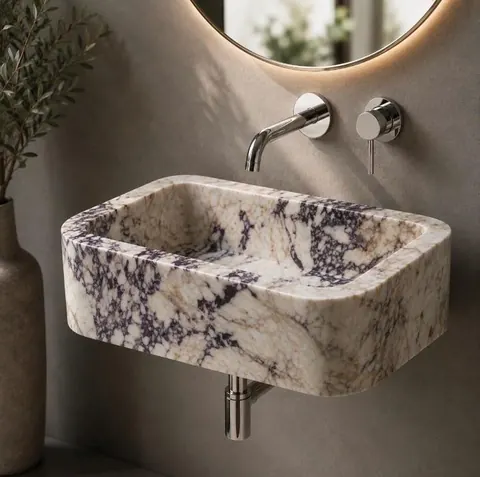
- A wall-mounted sink leaves the floor clear and lets you set the rim at any height.
- Code minimums are the same for both: 15 in from centerline to a side wall, 21 in clear in front.
- A wall-mounted stone sink hangs on steel brackets fixed into masonry or solid blocking, never plasterboard alone.
- MarbleSinkCo wall-mounted stone sinks start at $727; brackets are sold separately.
- A stone vessel sink on a low cabinet is the middle route: storage plus carved stone.
Where to buy: MarbleSinkCo pieces are made to order and sold only through the MarbleSinkCo Etsy shop, marblesinkco.etsy.com.
A bathroom vanity is a cabinet with a counter and a sink. A wall-mounted sink hangs from the wall with nothing under it. Both do the same job at the same height, so the choice comes down to storage, floor space, what the wall can carry and what you want to see. This guide compares the two, with the numbers that matter for a stone sink.
Is a wall-mounted sink or a vanity better?
A vanity is better when you need storage and want the plumbing hidden. A wall-mounted sink is better when floor space is tight, as in a powder room, or when you want to choose the rim height freely. The clearances required around the sink are the same for both, so a wall-mounted sink saves floor area and visual bulk, not wall width.
| Vanity cabinet with sink | Wall-mounted sink | |
|---|---|---|
| Storage under the sink | Yes: drawers or doors | None |
| Plumbing | Hidden in the cabinet | On show: trap and valves need a finish |
| Floor | Covered by the cabinet or its legs | Clear, easy to clean |
| Height | Fixed by the cabinet, plus the top | Any rim height, set by the brackets |
| Wall preparation | Little: a freestanding cabinet stands on the floor | Solid backing or masonry for the brackets |
| Knee space for seated use | No, unless the cabinet is open below | Yes |
| Changing it later | Swap the cabinet or the top | New bracket holes and pipe positions |
| Best for | Main and family bathrooms | Powder rooms, small bathrooms, accessible layouts |
How much space does each one need?
A wall-mounted sink and a vanity need the same clearances. Building codes require at least 15 in (38 cm) from the centerline of a lavatory to a side wall and 21 in (53 cm) of clear floor in front. The NKBA recommends 20 in (51 cm) and 30 in (76 cm). These figures are from NKBA guidance on the placement of bath fixtures, published in Supply House Times.
The same guidance asks for at least 4 in (10 cm) between the edge of a wall-hung or pedestal lavatory and a side wall. Local codes can differ, so confirm with your building department.
Where a wall-mounted sink gains is depth, front to back. MarbleSinkCo designs listed in a nominal 12 in (30 cm) width are 7.9 to 12 in (20 to 30 cm) deep, and designs listed at 24 in (60 cm) are 11.8 to 23.6 in (30 to 60 cm) deep. A shallow basin keeps the walkway clear in a narrow room. The small powder room guide covers the smallest layouts, and the vanity sink size pages list the depth of every design.
What does the wall need for a wall-mounted sink?
A wall-mounted sink needs a wall that carries its whole weight. Masonry and concrete take the bracket fixings directly. A stud wall needs solid blocking between the studs at bracket height before the wall is closed. Plasterboard, tile or hollow-wall anchors alone are not enough for any wall-hung sink, and least of all for stone.
Manufacturers say the same of ceramic fixtures. A Kohler installation guide for wall-mounted lavatories tells installers to fit sufficient backing behind the finished wall to support the mounting hardware.
For a stone sink the load is higher. Among MarbleSinkCo listings that state a weight, a 19.7 x 11.8 x 4.7 in (50 x 30 x 12 cm) wall-mounted basin is about 32 kg (71 lb) and a 29.5 x 15.7 x 5.9 in (75 x 40 x 15 cm) basin is about 60 kg (132 lb). Ask the shop for the weight of the design in your size and give it to the installer. MarbleSinkCo sells steel brackets separately and does not publish a load rating for them.
The sequence is in the wall-mounted stone sink installation planning guide and in stone sink weight and wall support. A freestanding vanity avoids all of this: the floor carries the load.
Which is easier to set at the right height?
A wall-mounted sink is easier to set at the right height, because the rim goes wherever the brackets put it. A vanity fixes the counter at the height of the cabinet plus the top. NKBA guidance gives 32 to 43 in (81 to 109 cm) above the finished floor as the lavatory height range for adults.
For a wall-mounted stone sink, mark the rim line and subtract the height of the stone to find the top of the brackets. A sink 6.7 in (17 cm) tall with a 34 in (86 cm) rim needs the bracket tops at about 27.3 in (69 cm).
Where the ADA Standards apply, the U.S. Access Board gives a maximum of 34 in (86 cm) to the rim or counter and knee clearance at least 27 in (69 cm) high and 30 in (76 cm) wide. An open wall-mounted sink can provide that knee space and a closed cabinet cannot. MarbleSinkCo sinks are not certified to any accessibility standard, so the layout has to be confirmed by your designer or code official.
What about storage and the pipes?
A vanity wins on storage and on hiding the pipes. Under a wall-mounted sink the trap and the supply valves are visible, so they need to be chosen for looks: usually a bottle trap and valves in the same finish as the faucet. Storage moves to a mirrored cabinet, a recessed niche or a tall unit beside the sink.
A wall-mounted sink is the easier one to keep clean. There is no cabinet base or toe kick, and the floor can be mopped wall to wall.
What does each option cost?
A wall-mounted stone sink is one purchase plus brackets and wall work. A vanity is a cabinet, a top, a sink and usually more cabinetry labour. The totals overlap, so compare quotes for your own room.
For the stone part, MarbleSinkCo prices are published in the stone sink price index. Sinks start at $727 in the smallest size and most cost $900 to $3,000, with free worldwide shipping.
| Sink width | Median listed price |
|---|---|
| Up to 16 in (41 cm) | $1,242 |
| 17 to 20 in (43 to 51 cm) | $1,532 |
| 21 to 24 in (53 to 61 cm) | $1,831 |
| 25 to 30 in (64 to 76 cm) | $2,352 |
| 31 to 36 in (79 to 91 cm) | $2,751 |
| 37 to 48 in (94 to 122 cm) | $3,395 |
Not included in those prices: steel brackets, the faucet, the drain, the trap, wall preparation and installation.
Is there a middle route?
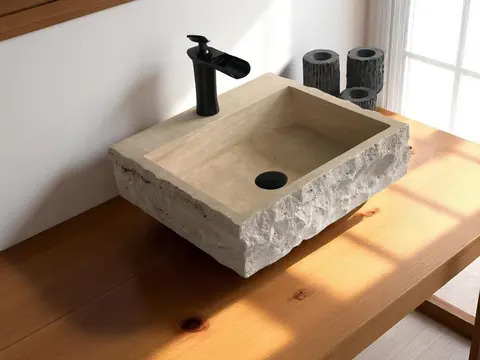
Yes: a stone vessel sink on a low cabinet. The cabinet keeps the storage and hides the pipes, and the carved stone sits on top. The cabinet has to be lower than a normal vanity and built for the weight, as set out in which vanity can carry a stone vessel sink.
A floating vanity cabinet is the other middle route: storage with a clear floor. It needs the same wall backing as a wall-mounted sink. MarbleSinkCo lists three handmade wood floating vanity cabinets at $1,468 each and one travertine vanity desk in the travertine vanity sinks collection. It does not sell complete vanity sets with plumbing.
When should you choose each one?
Choose a wall-mounted sink if:
- the room is a powder room or a narrow bathroom
- storage can go elsewhere
- the wall is masonry, or it will be open during the work so blocking can go in
- seated or wheelchair use needs knee space
- you want the stone itself to be the vanity
Choose a vanity cabinet if:
- the bathroom is used every day by more than one person and needs drawers
- the wall cannot be opened or reinforced
- you want the trap and valves out of sight
- you may change the sink or the top later without touching the wall
What MarbleSinkCo makes
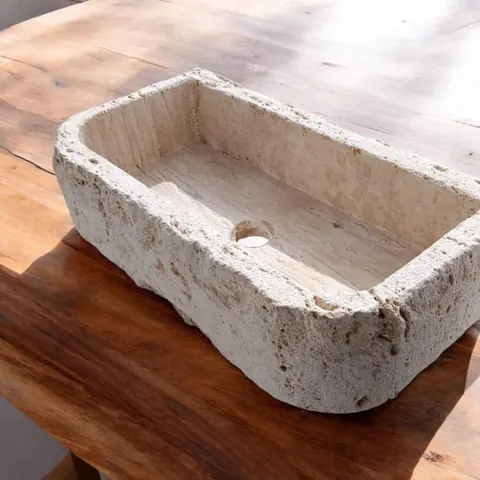
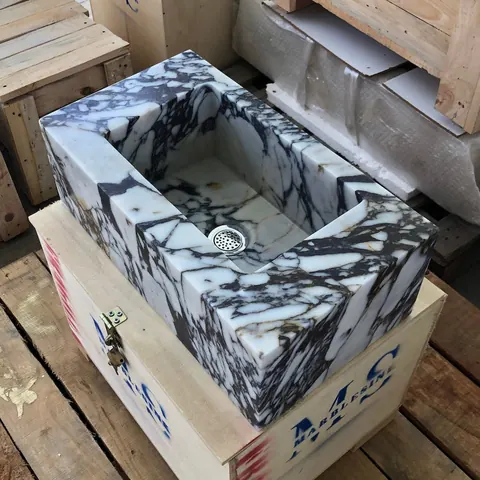
MarbleSinkCo carves stone sinks by hand in Türkiye, made to order in about 2 weeks. At the time of writing the shop lists 139 wall-mounted stone sink designs and 72 vessel designs, in widths from 7.9 to 70.9 in (20 to 180 cm). All are single-bowl basins. The wall-mounted sink collection and the vessel sink collection show them, and the bathroom vanity sinks page sorts them by vanity width.
The limits: no returns on made-to-order pieces, no warranty, brackets sold separately, and no cabinets beyond the three wood designs named above.
Sources
- Supply House Times with the National Kitchen & Bath Association: NKBA placement of bath fixtures (centerline, floor and edge clearances, lavatory height range)
- U.S. Access Board: Guide to the ADA Standards, lavatories and sinks (34 in maximum, knee clearance)
- Kohler: installation guide for wall-mounted semi-pedestal lavatories (backing behind the finished wall)
Frequently asked questions
Is a wall-mounted sink better than a vanity?+
A wall-mounted sink is better when floor space is tight and storage is not needed, as in a powder room. A vanity is better in a main bathroom where toiletries need a home and the pipes should be hidden. Neither is better in general: the choice is storage and hidden plumbing against open floor and a freely chosen height.
Does a wall-mounted sink save space?+
It saves floor space, not wall width. The floor under the sink stays clear, which makes a small room look larger and easier to clean, and the basin can be shallower than a cabinet. The clearances do not change: codes require 15 in (38 cm) from the sink centerline to a side wall and 21 in (53 cm) clear in front.
Can any wall hold a wall-mounted stone sink?+
No. A masonry or concrete wall can take the bracket fixings directly. A stud wall needs solid timber blocking between the studs at bracket height before it is closed, so in a renovation the wall usually has to be opened. Plasterboard or tile alone will not hold a stone sink. Ask the seller for the weight of the piece.
How high should a wall-mounted sink be?+
Set the rim where it suits the users. NKBA planning guidance gives 32 to 43 in (81 to 109 cm) above the finished floor for adults. Where the ADA Standards apply, the rim can be no higher than 34 in (86 cm), with knee clearance at least 27 in (69 cm) high under the sink.
Is a wall-mounted sink cheaper than a vanity?+
It depends on the sink. A wall-mounted sink needs no cabinet and no separate top, but it needs brackets, wall preparation and a trap that looks good on show. MarbleSinkCo wall-mounted stone sinks start at $727 in the smallest size, and the median listed price across all MarbleSinkCo sinks 21 to 24 in wide is $1,831. Brackets are sold separately.
Can I have storage with a wall-mounted stone sink?+
Not under the sink itself. Storage has to go elsewhere: a mirrored cabinet above, a recessed niche or a tall unit beside the basin. If storage under the sink matters, a stone vessel sink on a low cabinet keeps the drawers and still puts carved stone in the room.