Short answer
A travertine sink is worth it if you want a warm, textured natural stone and will seal it about once a year. Its advantages are an earthy colour that hides water marks, a matte surface that is forgiving in daily use, and made-to-measure sizes. Its drawbacks are natural pores that must be filled and sealed, sensitivity to acids, and weight.
- Travertine is a limestone formed at mineral springs, with natural pores and banding.
- Its beige to walnut colour and matte finish hide water spots and fine scratches better than polished white marble.
- The pores are normally filled; filler can wear over time and is simple to renew.
- Like marble it is calcium-based: no vinegar, bleach or limescale removers.
- Seal with a penetrating sealer about once a year.
- One travertine design is listed in 28 sizes from 12 to 48 inches wide, priced from $727 to $3,947.
Where to buy: MarbleSinkCo pieces are made to order and sold only through the MarbleSinkCo Etsy shop, marblesinkco.etsy.com.
Travertine is the warm, banded stone of Roman baths and Mediterranean courtyards. As a sink it behaves much like marble, with a few differences that make it easier to live with for some people and less suitable for others.
What travertine is
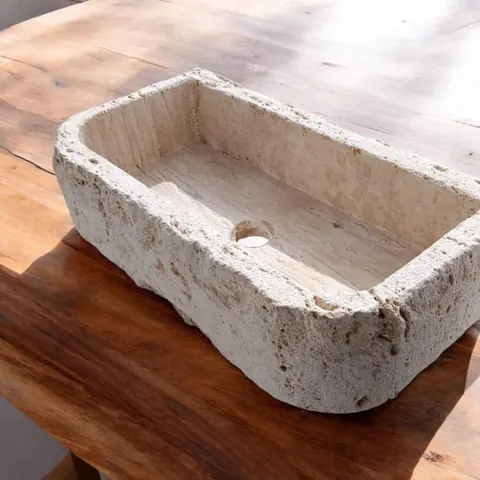
Travertine is a type of limestone laid down by mineral springs. As the stone forms, gas bubbles and plant matter leave small pores, and the layers build up as bands. Cut across the layers it shows straight lines; cut along them it shows a softer, cloudier pattern. Colours run from ivory and beige to walnut brown. Like marble, it is made of calcium carbonate and sits at about 3 to 4 on the Mohs hardness scale.
The advantages of a travertine sink
Warm colour. White marble can look cool in a room with little daylight. Travertine brings beige and honey tones that sit well with wood, plaster, brass and terracotta.
It hides everyday marks. Water spots, soap film and fine scratches show clearly on a polished white surface. On honed, banded travertine they are hard to see, which is why many owners find it less demanding day to day.
A matte, non-reflective finish. Travertine is normally honed. There is no shine for an etch mark to interrupt, and the surface is simple to touch up.
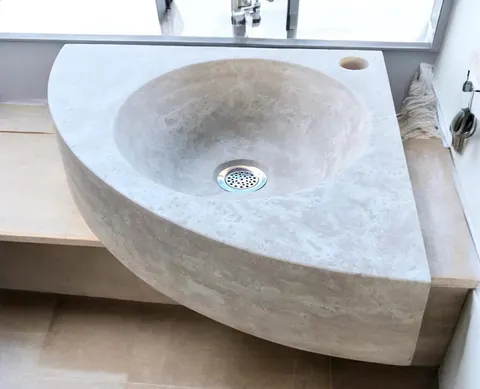
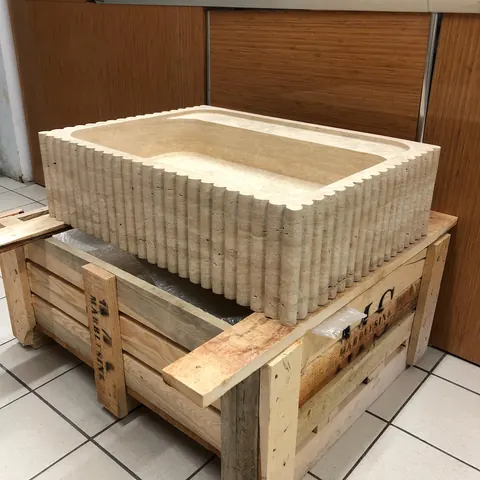
Made to measure. Each sink is carved for the order, so width, depth, drain position and tap holes can be changed. One travertine vanity sink design is listed in 28 sizes from 12 to 48 inches wide; see the vanity sinks by size pages for what is available at each width.
Good value among natural stones. At the same width, travertine is usually priced a little below strongly veined marbles such as Calacatta Viola. The price index compares stones.
The drawbacks of a travertine sink
Pores need filling and sealing. The natural voids are filled so that the bowl is smooth. Over years of use small areas of filler can wear and need renewing, which is a simple repair. The whole sink needs a penetrating sealer about once a year.
Acids etch it. Travertine is calcium-based, so vinegar, citrus, bleach and limescale removers dull the surface exactly as they do on marble. Use a pH-neutral cleaner.
It is usually honed, not glossy. Travertine can be polished, but most travertine sinks are finished honed and filled. If you want a high-gloss sink, marble is the more common choice.
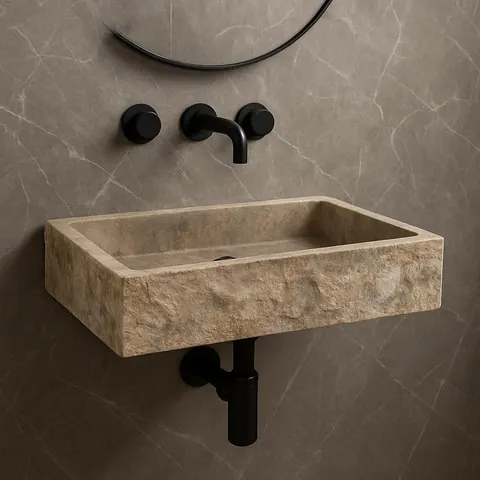
It is heavy. Solid stone needs planned support: a solid counter under a vessel sink, and steel brackets fixed into masonry or timber blocking for a wall-mounted one. Estimate the load with the weight calculator.
Made to order. Carving takes about 2 weeks, and a piece made for one order cannot be returned, so confirm dimensions and drain position first.
Travertine sink pros and cons at a glance
| Advantage | Drawback | |
|---|---|---|
| Look | Warm beige to walnut tones, natural banding | No high-gloss finish |
| Daily use | Hides water spots and fine scratches | Etches with acids |
| Surface | Honed finish is easy to touch up | Filled pores may need renewing over time |
| Upkeep | Simple wipe and pH-neutral cleaner | Sealing about once a year |
| Fitting | Custom sizes, wall-mount or vessel | Heavy; needs planned support |
| Cost | Often a little less than rare marbles at the same size | More than ceramic |
Filled or unfilled?
Inside the bowl, travertine should be filled so that water and soap have nowhere to collect. On the outside faces, an unfilled or lightly filled surface shows the stone’s natural texture and is a matter of taste. If you have a preference, say so before carving starts.
Travertine or marble?
Choose travertine for warmth, texture and a surface that disguises daily use. Choose marble for a brighter white, stronger veining or a polished finish. Care and weight are the same for both. The full comparison is in marble vs travertine for a bathroom sink, and the equivalent guide for marble is marble sink pros and cons.
Care in five steps
- Seal when installed and about once a year after that.
- Wipe the bowl dry after use.
- Clean with a pH-neutral stone cleaner or mild dish soap and water.
- Keep vinegar, bleach and limescale removers away from the stone.
- If filler wears, have it renewed before water sits in the pore.
The detailed routine is in the travertine sink care guide.
For how these choices are changing in 2026, read the stone bathroom sink trends guide for 2026.
Frequently asked questions
Is travertine good for a bathroom sink?+
Yes. Travertine has been used in wet rooms for centuries. For a sink it should be filled, honed and sealed, and cleaned with a pH-neutral product. With that care it is a practical everyday basin, and its colour hides water marks well.
Do travertine sinks stain?+
Unsealed travertine absorbs liquids because it is porous. A penetrating sealer, renewed about once a year, slows absorption so spills can be wiped away. The beige and brown tones of the stone also make light marks far less visible than on white marble.
What are the holes in travertine?+
They are natural pores left by gas bubbles and plant matter when the stone formed at a mineral spring. In a sink they are normally filled with a matching filler so the bowl is smooth and easy to clean. Some designs leave the outside unfilled for texture.
Is travertine harder to maintain than marble?+
No, the care is the same: pH-neutral cleaner, no acids, sealing about once a year. Travertine is often easier to live with because its matte surface and warm colour disguise etching and water spots that would show on polished marble.
How much does a travertine sink cost?+
In the MarbleSinkCo Etsy shop, travertine sinks start at $727 in the smallest size. One travertine vanity sink design is listed in 28 sizes from 12 to 48 inches wide, priced from $727 to $3,947; the 24 x 12 x 4 inch size is $1,647. Shipping is free and US import duties are included at Etsy checkout.
How long does a travertine sink last?+
Travertine is solid stone with no glaze to wear through. Used and cared for properly it lasts for decades, and the surface can be re-honed or the filler renewed if it becomes worn.