Stone Sink Weight Calculator
Enter the outside dimensions of the sink and the size of the bowl, choose the stone, and get an estimated weight in pounds and kilograms. Use it to plan wall blocking, brackets, vanity support and lifting.
How the weight of a stone sink is calculated
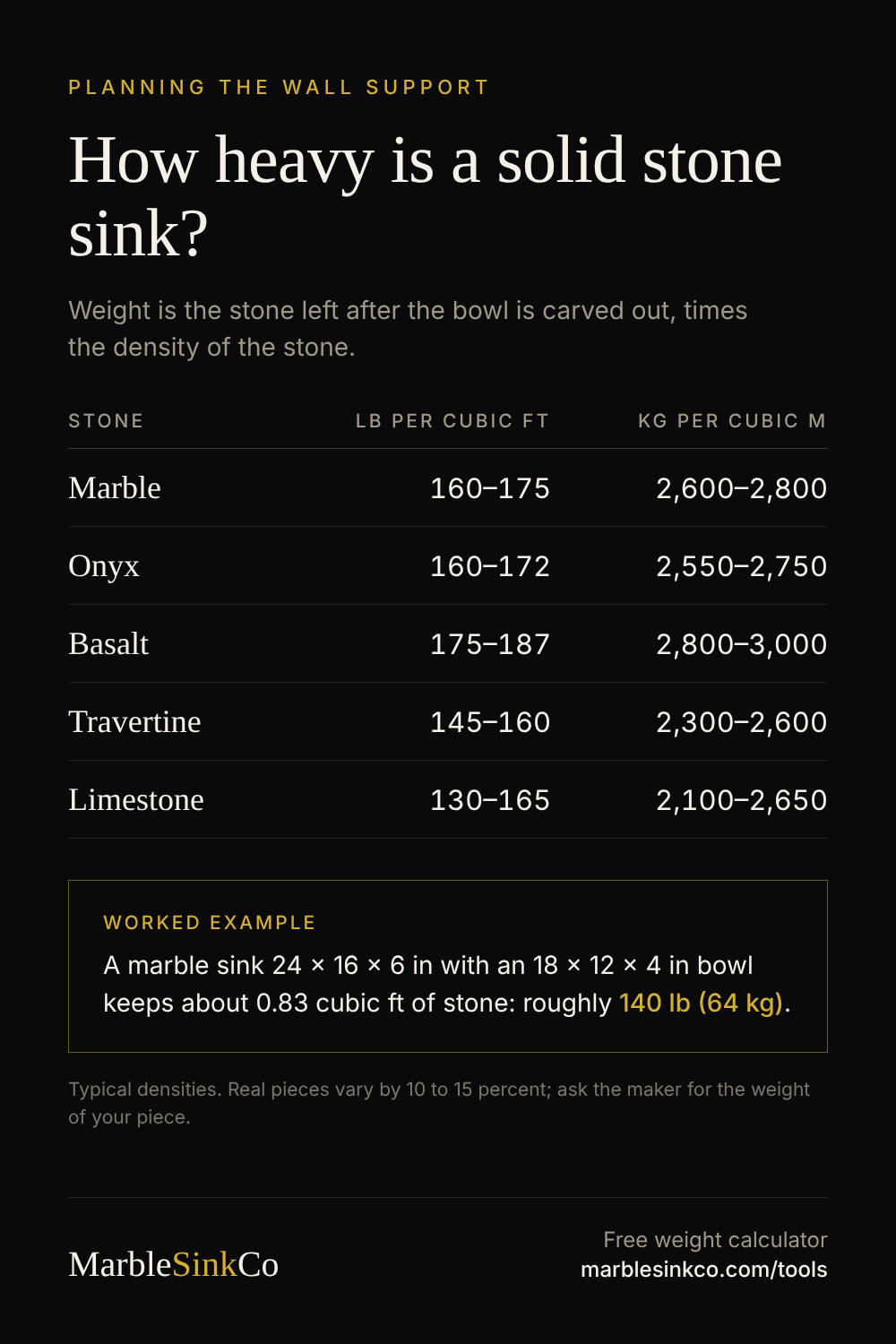
A carved sink is a block of stone with a bowl removed. Its weight is the volume of stone that is left, multiplied by the density of the stone:
weight = (outer length × width × height − bowl volume) × density
For a rectangular bowl the bowl volume is length × width × depth. For a round or oval bowl the calculator treats it as half an ellipsoid, which is close to the shape of most carved bowls: (π ÷ 6) × length × width × depth.
In inches, divide the cubic inches by 1,728 to get cubic feet, then multiply by the density in pounds per cubic foot. In centimetres, divide the cubic centimetres by 1,000,000 to get cubic metres, then multiply by the density in kilograms per cubic metre.
Density of common sink stones
| Stone | Typical density (kg/m³) | Typical density (lb/ft³) | Value used here |
|---|---|---|---|
| Marble | 2,600 to 2,800 | 160 to 175 | 2,700 kg/m³ |
| Travertine | 2,300 to 2,600 | 145 to 160 | 2,450 kg/m³ |
| Basalt | 2,800 to 3,000 | 175 to 187 | 2,900 kg/m³ |
| Onyx (banded calcite) | 2,550 to 2,750 | 160 to 172 | 2,650 kg/m³ |
| Limestone | 2,100 to 2,650 | 130 to 165 | 2,400 kg/m³ |
| Granite | 2,600 to 2,800 | 160 to 175 | 2,700 kg/m³ |
Natural stone varies from block to block, which is why the result is shown with a range of about 10 percent either way.
What to do with the number
- Wall-mounted sinks: size the blocking and brackets for the weight of the sink plus the load of someone leaning on the rim. See stone sink weight and wall support and planning a wall-mounted installation.
- Vessel sinks: check that the vanity top and cabinet can carry the load at the point where the sink sits. The vessel sink guide covers counters and faucets.
- Lifting: plan two people for anything over about 50 lb (23 kg), and never lift a sink by an unsupported rim.
- Bathtubs: a tub also carries water at 8.34 lb per US gallon and a bather. Use the stone bathtub planning guide and have a structural engineer confirm the floor.
Looking for a sink to go with the numbers? Browse wall-mounted stone sinks, vessel sinks or compare every design by size and price in the sink finder.
Frequently asked questions
How much does a marble sink weigh?+
It depends on the size and how much stone is left around the bowl. Marble weighs about 2,700 kg per cubic metre (roughly 168 lb per cubic foot). A small vessel bowl often lands between 25 and 50 lb, a mid-size rectangular basin between 60 and 100 lb, and a long wall-mounted trough can pass 150 lb. Use the calculator above for your own dimensions.
How do you calculate the weight of a stone sink?+
Work out the volume of the outer block, subtract the volume of the bowl that was carved out, and multiply the result by the density of the stone. In inches: (outer length x width x height minus bowl length x width x depth) divided by 1,728 gives cubic feet; multiply by about 168 for marble or 153 for travertine to get pounds.
Is travertine lighter than marble?+
Slightly. Travertine has natural pores, so its bulk density is usually 2,300 to 2,600 kg per cubic metre against 2,600 to 2,800 for marble. For the same shape, a travertine sink is typically 5 to 10 percent lighter.
Can drywall hold a wall-mounted stone sink?+
No. Drywall alone cannot carry a stone sink. The brackets must be fixed into masonry or into solid timber blocking set between the studs, sized for the full weight of the sink plus the load of someone leaning on it.
How accurate is this calculator?+
It is an estimate. Real sinks have rounded bowls, drain holes, sloped floors and stone that varies in density, so the true weight can differ by 10 to 15 percent. For a specific sink, ask the maker for the weight of that piece before you plan the support.
Add this calculator to your site
Designers, fabricators and renovation writers are welcome to embed the calculator for free. Copy the code below into your page; it adapts to light and dark themes.
You can also simply link to this page from your own site or project notes.