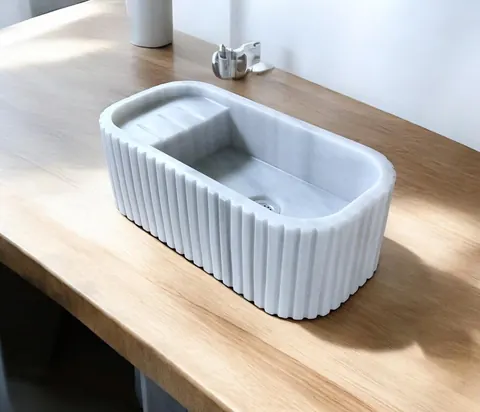
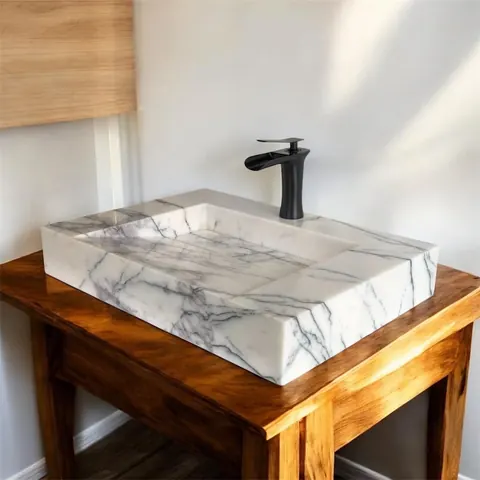
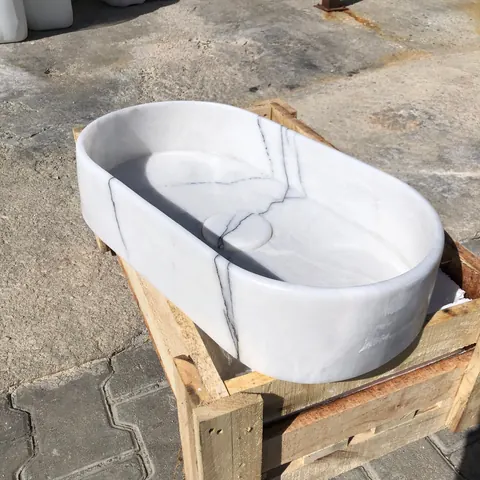
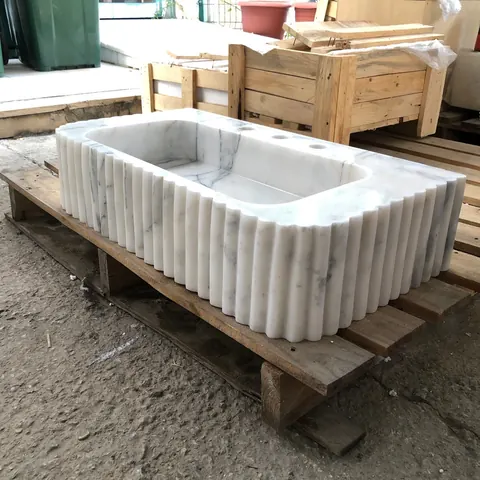
Short answer
Marble is a good material for a bathroom sink if you want natural stone and accept simple upkeep. The advantages are unique veining, a solid one-piece build, made-to-measure sizes and a surface that can be re-honed. The drawbacks are acid etching, sealing about once a year, weight that needs a strong wall or counter, and a higher price than ceramic: from $727, with a median starting price of $1,196.
- Marble is solid stone all the way through, so marks can be honed out instead of replacing the sink.
- Marble is calcite, about 3 on the Mohs scale: acids etch it and grit scratches it. Use a pH-neutral cleaner.
- Seal with a penetrating sealer about once a year and wipe the bowl dry after use. Sealer does not stop etching.
- Solid stone is heavy, roughly 160 to 170 lb per cubic foot. A wall-mounted marble sink needs masonry or timber blocking behind it.
- Hand-carved marble sinks start at $727 in the smallest size; most cost $900 to $3,000.
- A powder room or guest bathroom is the easiest place to live with marble; a busy family bathroom needs more care.
Where to buy: MarbleSinkCo pieces are made to order and sold only through the MarbleSinkCo Etsy shop, marblesinkco.etsy.com.
A marble sink is carved from a single block of stone. That one fact explains almost every advantage and every drawback in this guide: it is why the sink looks the way it does, why it lasts, why it is heavy, and why it reacts to acids. We carve these sinks, so this guide states the drawbacks as plainly as the advantages.
Is marble good for a bathroom sink?
Marble is a good material for a bathroom sink if you want natural stone and accept simple upkeep. A marble sink is solid stone, lasts for decades, can be carved to a custom size and can be re-honed if it is marked. In return, acids etch it, it needs sealing about once a year, it is heavy and it costs more than ceramic.
Marble is a poor choice in two cases: if you want a sink that needs no care at all, and if the people using the bathroom will clean it with acidic or abrasive products.
What are the advantages of a marble sink?
The advantages of a marble sink are its unique veining, its solid one-piece build, made-to-measure sizes and a surface that can be renewed.
Every sink is different. Veining is a natural pattern, so no two blocks match. A marble sink is the one fixture in a bathroom that cannot be repeated in the house next door.
It is solid all the way through. A ceramic sink is a clay body with a thin glaze, and a chip in the glaze is permanent. Marble has no coating. A scratch or a dull spot sits in the same material as the rest of the sink, so it can be honed out by a stone restorer.
It can be made to measure. Because each sink is carved for the order, the width, depth, drain position, tap holes and finish can be changed. That matters in a narrow powder room or an alcove where standard ceramic sizes do not fit. The bathroom vanity sinks by size pages show which designs come in which widths.
It suits wall-mounting. A wall-mounted marble basin is the counter and the bowl in one piece, with no cabinet below, which keeps a small room open.
It ages instead of wearing out. A honed marble sink develops a soft patina over years of use. Some owners prefer it to the look of a new one, and those who do not can have the sink re-honed.
What are the disadvantages of a marble sink?
The disadvantages of a marble sink are etching from acids, the need for sealing, its weight, its price and the terms that come with a made-to-order piece.
Acids etch it. Marble is made mainly of calcite, a calcium carbonate mineral that reacts with acids (Geology.com). Vinegar, lemon juice and nearly all limescale removers leave a dull mark. Etching is the most common complaint about marble, and it is avoided by using a pH-neutral cleaner and rinsing spills away.
It needs sealing. Marble is slightly porous. A penetrating sealer, applied about once a year, works below the surface so that liquids stay on top long enough to be wiped off. The Natural Stone Institute notes that sealing makes stone more stain resistant, not stain proof.
It scratches more easily than porcelain. Marble has a hardness of about 3 on the Mohs scale, where quartz is 7. Grit and abrasive pads can mark it.
It is heavy. Marble weighs roughly 160 to 170 lb per cubic foot: the ASTM C503 specification sets a minimum of 162 lb per cubic foot (2,590 kg per cubic meter) for calcite marble, according to the Natural Stone Council fact sheet. Plan the support before the sink arrives: a solid counter for a vessel sink, and masonry or timber blocking for a wall-mounted one. The weight calculator gives an estimate for any size.
It costs more than ceramic. A hand-carved sink needs a solid block of stone and hours of hand work. Prices start at $727 for the smallest size and rise mainly with width.
It is made to order. Carving takes about 2 weeks before shipping. Because each piece is made for one order, it cannot be returned, and MarbleSinkCo does not offer a warranty. Check the dimensions, drain position and tap holes carefully before ordering.
Marble sink pros and cons at a glance
| Advantage | Drawback | |
|---|---|---|
| Look | Unique veining, one piece of stone | Pattern cannot be matched exactly to a photo |
| Surface | Can be re-honed if marked | Etches with acids, scratches more easily than porcelain |
| Upkeep | Simple daily wipe | Sealing about once a year, pH-neutral cleaners only |
| Fitting | Custom sizes, wall-mount or vessel | Heavy; needs planned support |
| Cost | Lasts for decades | From $727; median starting price $1,196 |
| Ordering | Made to your dimensions | About 2 weeks to carve, no returns, no warranty |
Do marble sinks stain, scratch or etch?
Marble sinks can stain, scratch and etch, and the three are different kinds of damage with different fixes. Etching is the most common, staining is the most preventable, and scratching is the least likely in a bathroom.
| Damage | What it looks like | Cause | How to prevent it | How to fix it |
|---|---|---|---|---|
| Etch | Dull, pale patch | Acids: vinegar, citrus, limescale remover, some toiletries | pH-neutral cleaner, rinse spills | Marble polishing powder, or re-honing |
| Stain | Darker or colored patch | Hair dye, makeup, coffee, oil left to sit | Penetrating sealer, wipe spills | Poultice for 24 to 48 hours |
| Scratch | Fine line | Grit, metal, abrasive pads | Soft cloths, no scouring powder | Re-honing |
| Hard water marks | White deposit | Tap water drying on the stone | Wipe the bowl dry | Dry 0000 steel wool, never limescale remover |
The fixes in the table follow the Natural Stone Institute stain removal guide. The step-by-step version is in our marble sink care, sealing and stain removal guide.
Are marble sinks hard to maintain?
A marble sink is not hard to maintain, but it has rules. The routine is short, and what matters most is what you keep away from the stone.
- Seal the sink when it is installed and about once a year after that.
- Wipe the bowl dry after use so hard water does not leave deposits.
- Clean with a pH-neutral stone cleaner or mild dish soap and water.
- Keep vinegar, limescale remover, scouring powder and abrasive pads away from the stone.
- Rinse away hair dye, makeup and perfume straight away.
Followed as a habit, these five steps take about a minute a day and remove most of the reasons people regret a marble sink.
How long does a marble sink last?
A marble sink lasts for decades when it is used and cared for properly. The stone is solid all the way through, so there is no glaze or gel coat to wear off, and etch marks and fine scratches can be honed out more than once. What usually ends the life of a marble sink is a crack from an impact, not surface wear.
How much does a marble sink cost?
A hand-carved marble sink costs from $727 in the smallest size, and most cost $900 to $3,000. In our price index of 2,124 size options on 181 designs, the median starting price is $1,196 and the price runs at about $83 per inch of width. Shipping is free and US import duties are included at Etsy checkout.
| Width | Median listed price |
|---|---|
| Up to 16 in (41 cm) | $1,242 |
| 17 to 20 in (43 to 51 cm) | $1,532 |
| 21 to 24 in (53 to 61 cm) | $1,831 |
| 25 to 30 in (64 to 76 cm) | $2,352 |
| 31 to 36 in (79 to 91 cm) | $2,751 |
| 37 to 48 in (94 to 122 cm) | $3,395 |
The marble sink cost guide gives prices by stone and real examples, and the price index has the full tables.
Is a marble sink better than a porcelain sink?
Neither a marble sink nor a porcelain sink is better for everyone. Porcelain wins on easy care and price. Marble wins on material, custom sizing and the ability to renew the surface.
| Marble sink | Porcelain (vitreous china) sink | |
|---|---|---|
| Material | Solid natural stone, carved from one block | Fired clay with a glass-like glaze |
| Look | Natural veining, every piece different | Uniform, usually white |
| Cleaners | pH-neutral only | Most non-abrasive bathroom cleaners |
| Acids | Etch the surface | Glaze resists them |
| Sealing | About once a year | None |
| Damage | Etches and scratches can be honed out | A chip in the glaze cannot be honed out |
| Weight | Heavy; support must be planned | Lighter |
| Sizes | Carved to order, custom sizes | Catalog sizes |
| Price | Higher: from $727 at MarbleSinkCo | Lower |
| Availability | Made to order, about 2 weeks plus delivery | Usually in stock at retailers |
For a longer comparison, read marble sink vs ceramic. For the manufactured stone-look alternative, read marble vs quartz.
Honed or polished: which hides wear better?
A honed finish hides wear better than a polished finish. Honed marble is matte, so etching and fine scratches blend in and are easier to touch up. Polished marble shows the color and veining most strongly, but an etch mark stands out against the shine. For a sink that is used every day, honed is the more forgiving choice. The finish guide compares the two in detail.
Which rooms suit a marble sink?
A marble sink suits a powder room or guest bathroom best, because use is light and the sink is the feature of the room.
- Powder room or guest bathroom: the best fit. Light use, mostly hand washing.
- Primary bathroom: works well with a honed finish and the habit of wiping the bowl dry.
- Children’s or shared family bathroom: possible, but toothpaste and colored products left to sit will mark it. Choose honed marble and seal it on schedule.
- Kitchen: the hardest setting, because food acids are constant. Expect a patina, not a pristine surface.
Who should choose something else?
Choose something other than marble if you want a sink you never have to think about, or if you rely on strong bathroom cleaners. Glazed ceramic is the better choice in both cases. If you like the look of stone but want a harder, more acid-resistant surface, compare granite and marble. If you want a warmer, more textured stone with similar care, see the travertine sink pros and cons.
Sources
- Geology.com, Marble and Mohs hardness scale: composition, hardness and reaction with acids.
- Natural Stone Institute, Care and Cleaning of Natural Stone and Stain Removal Guide: cleaners, sealers, stains and etch marks.
- Natural Stone Council, Marble material fact sheet: ASTM C503 density.
- MarbleSinkCo, Stone Sink Price Index: all prices in this guide.
Frequently asked questions
Is marble good for a bathroom sink?+
Marble is a good material for a bathroom sink if you accept simple upkeep. A marble sink is solid stone carved from one block, so it lasts for decades and its surface can be re-honed. The trade-offs are that acids etch it, it needs a penetrating sealer about once a year, it is heavy, and it costs more than ceramic.
Do marble sinks stain easily?+
Unsealed marble absorbs colored liquids such as hair dye, makeup and coffee. A penetrating sealer slows this down and gives you time to wipe spills away, but it makes the stone stain resistant, not stain proof. Most stains that do set can be drawn out with a poultice left on for 24 to 48 hours. Dull spots from acids are etching, not staining.
Do marble sinks scratch?+
Marble sinks can scratch, because marble has a hardness of about 3 on the Mohs scale, softer than a steel knife blade at about 5 to 6.5 and far softer than quartz at 7. Grit, metal cans and abrasive pads can mark it. Light scratches can be honed out, because the stone is solid all the way through, and a honed finish hides them best.
Do marble sinks etch?+
Yes. Marble is made of calcite, which reacts with acids. Vinegar, lemon juice, limescale removers and many bathroom cleaners dissolve a thin layer of the surface and leave a dull, pale mark called an etch. Sealer does not prevent etching. A pH-neutral cleaner prevents it, a honed finish hides it, and re-honing removes it.
Are marble sinks hard to maintain?+
A marble sink is not hard to maintain, but it has rules. Wipe it dry after use, clean it weekly with a pH-neutral stone cleaner or mild dish soap, and reseal it about once a year. Never use vinegar, limescale remover, scouring powder or abrasive pads. Owners who want to clean with any product should choose glazed ceramic.
How long does a marble sink last?+
A marble sink lasts for decades when it is used and cared for properly. Marble is solid stone, so there is no glaze or coating to wear through, and etch marks and fine scratches can be honed out more than once. What usually ends the life of a marble sink is a crack from an impact, not surface wear.
Are marble sinks heavy?+
Yes. Marble weighs roughly 160 to 170 lb per cubic foot, so even a compact basin is far heavier than a ceramic one. A vessel sink needs a solid counter, and a wall-mounted sink needs steel brackets fixed into masonry or timber blocking. MarbleSinkCo does not publish product weights, so ask the shop for the weight of your size.
How much does a marble sink cost?+
In the MarbleSinkCo Etsy shop, hand-carved marble sinks start at $727 in the smallest size and most cost $900 to $3,000. The median starting price is $1,196 and price runs at about $83 per inch of width. Shipping is free and US import duties are included at Etsy checkout. Steel wall brackets are sold separately.
Is a marble sink better than a porcelain sink?+
Neither is better for everyone. A porcelain sink has a non-porous glaze, tolerates almost any bathroom cleaner and costs far less. A marble sink is solid natural stone, unique in its veining, can be made to a custom size and can be re-honed if marked, but acids etch it and it needs sealing about once a year.