To choose a bathroom sink, decide three things in order: how it mounts, what it is made of, and what size fits your room and faucet. For most bathrooms, a vitreous china undermount or drop-in sink 16 to 20 in wide is the low-cost, low-upkeep choice. Vessel, wall-mounted, glass and natural stone sinks cost more or need more care, and they suit rooms where floor space or appearance matters more than convenience.
Types of bathroom sinks
The mounting type comes first because it depends on what you already have: the vanity, the countertop material and the wall.
| Type | How it mounts | Good for | Watch for |
|---|---|---|---|
| Undermount | Fixed below a solid counter (stone, quartz, solid surface) | Busy bathrooms. Spills wipe straight into the bowl. | Not for standard laminate. Needs a fabricated cutout. |
| Drop-in | Rim rests on the counter over a cutout | Any counter, including laminate. Easy replacement. | The rim joint collects grime. |
| Vessel | Bowl sits on top of the counter | Powder rooms and feature sinks | Needs a lower counter and a tall or wall-mounted faucet. |
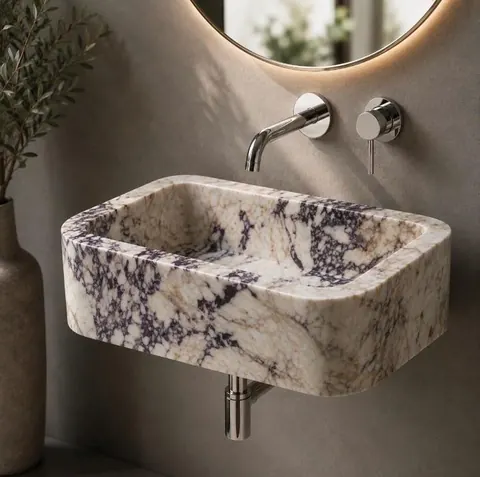
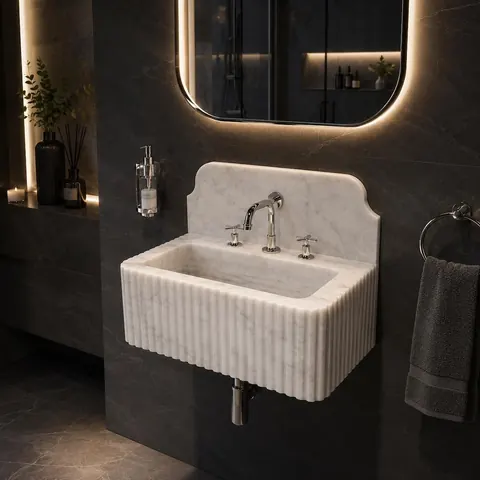
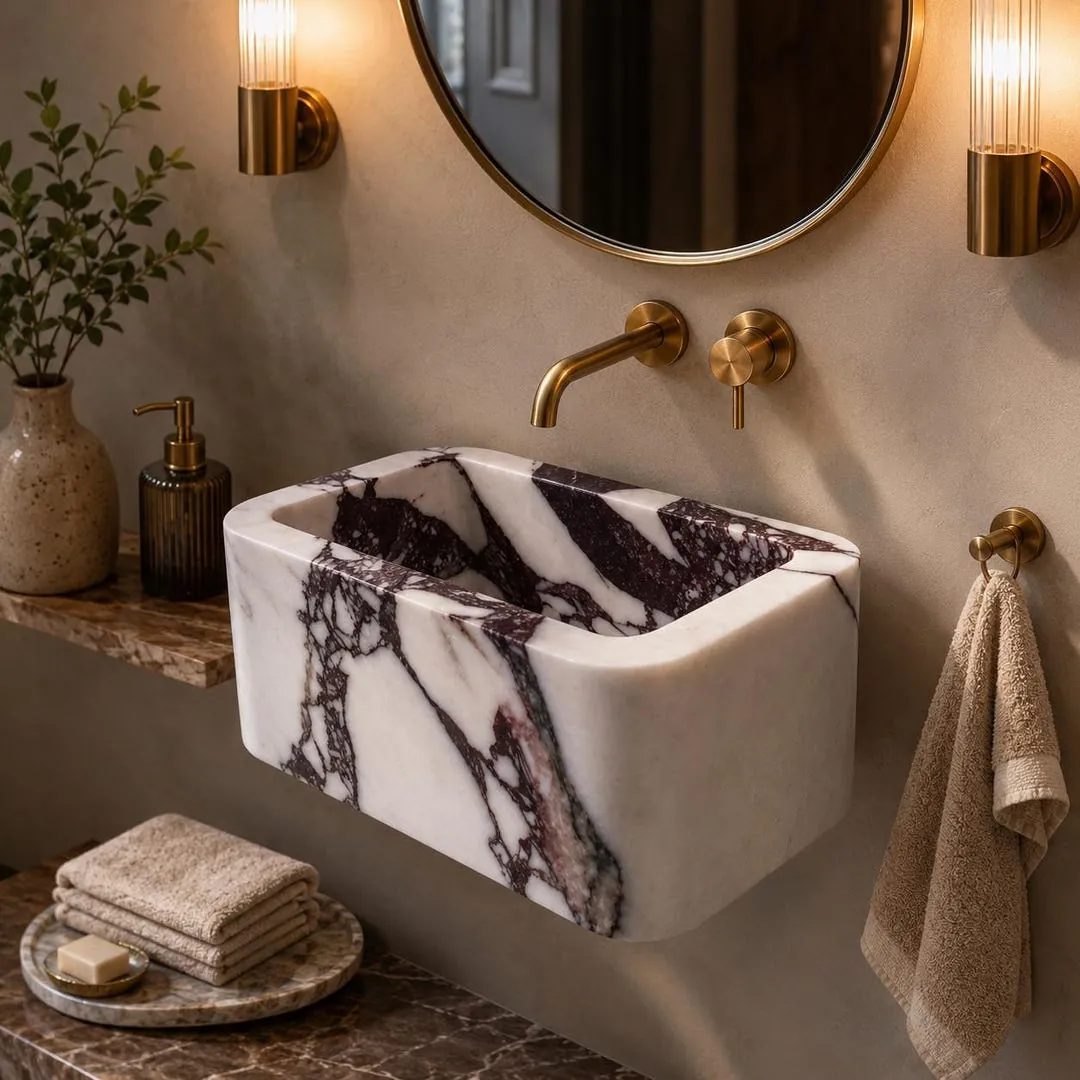
| Wall-mounted | Hung on a hanger or brackets fixed into framing | Small rooms, accessible bathrooms, easy floor cleaning | No storage. Exposed trap. Wall needs blocking. |
| Pedestal | Basin on a column, also anchored to the wall | Small traditional bathrooms | No storage and almost no counter space. |
| Console | Basin or top on two or four legs, usually fixed to the wall too | An open look with some surface area | Plumbing is on show. |
| Integrated | Bowl and countertop are one piece | The easiest cleaning. No joint. | Damage to the bowl means replacing the whole top. |
Two of these have their own trade-offs worth reading before you commit: see vessel sink pros and cons and wall-mount vs pedestal sinks.
Bathroom sink materials compared
Material sets the price, the upkeep and how the sink handles knocks. The price level below is a general ranking for the sink alone, not survey data. Prices vary widely by brand and size.
| Material | Price level | Strengths | Weaknesses |
|---|---|---|---|
| Vitreous china (glazed ceramic, often sold as porcelain) | Lowest | Non-porous glaze, stain resistant, the widest choice of sizes | A hard impact can chip or crack it. Chips are hard to hide. |
| Fireclay | Low to middle | Thick, dense body that resists chips and scratches better than standard china | Heavy. Fewer shapes. Sizes vary slightly between pieces. |
| Enameled cast iron | Middle | Very rigid, glossy enamel, long service life | Very heavy. Chipped enamel exposes iron that rusts. |
| Stainless steel | Low to middle | Will not chip or crack. Light. | Shows water spots and fine scratches. Looks utilitarian. |
| Tempered glass | Low to middle | Light, many colors, mostly vessel bowls | Shows every water spot. Can shatter from a sharp impact. |
| Solid surface and cultured marble | Low to middle | Seamless integrated bowls. Scratches in solid surface can be sanded out. | Scratches more easily than china. High heat can mark it. |
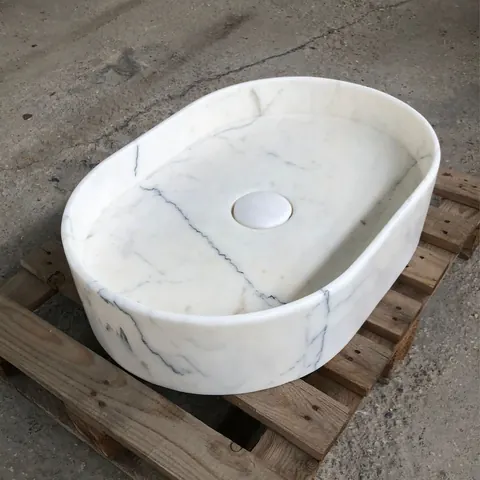
| Natural stone (marble, travertine, granite) | Highest | No two pieces alike. Solid material that can be re-honed. | Heavy. Marble and travertine etch from acids and need sealing. |
Glazed china, fireclay, cast iron and solid surface all clean with any non-abrasive bathroom cleaner. Stone needs more attention. Marble and travertine are made mainly of calcite, which has a hardness of 3 on the Mohs scale and reacts with acids, so vinegar, citrus and limescale removers leave dull etch marks. The Natural Stone Institute advises a neutral cleaner for these stones. We recommend sealing them with a penetrating sealer about once a year. Granite is a siliceous stone and resists most household acids.
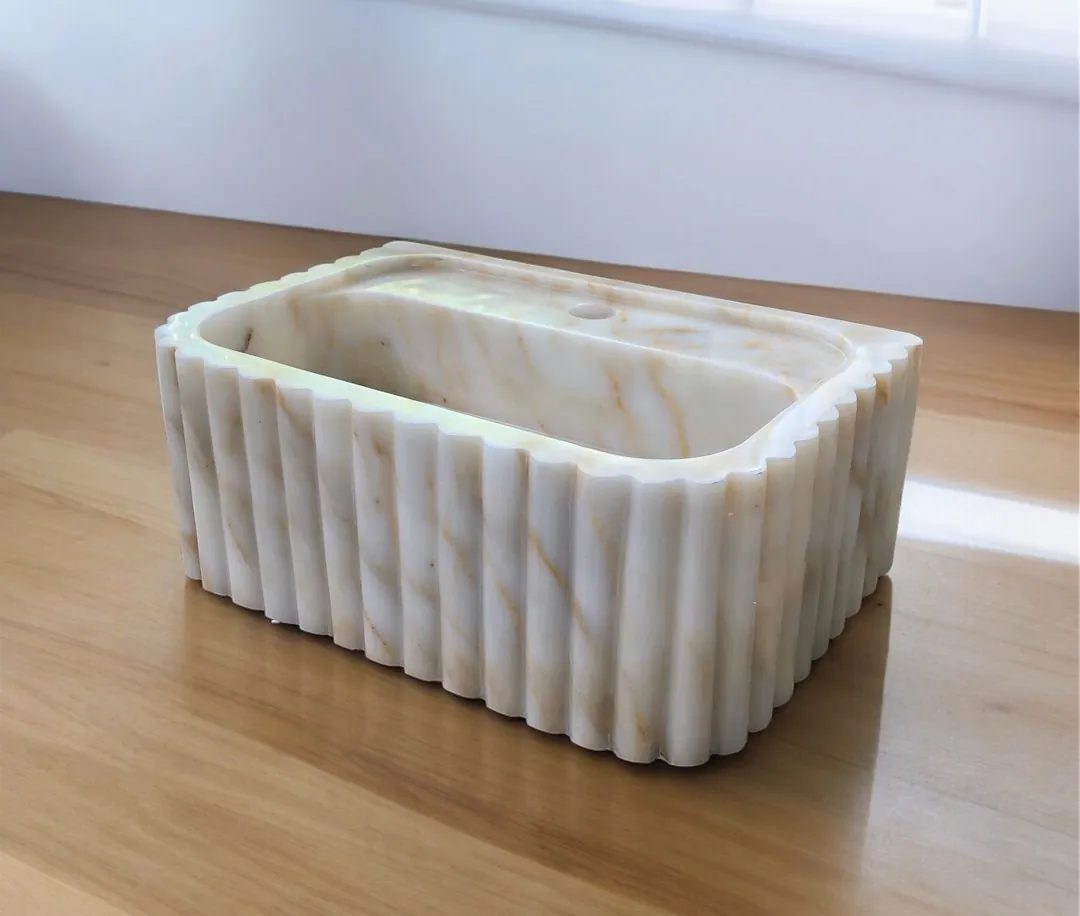
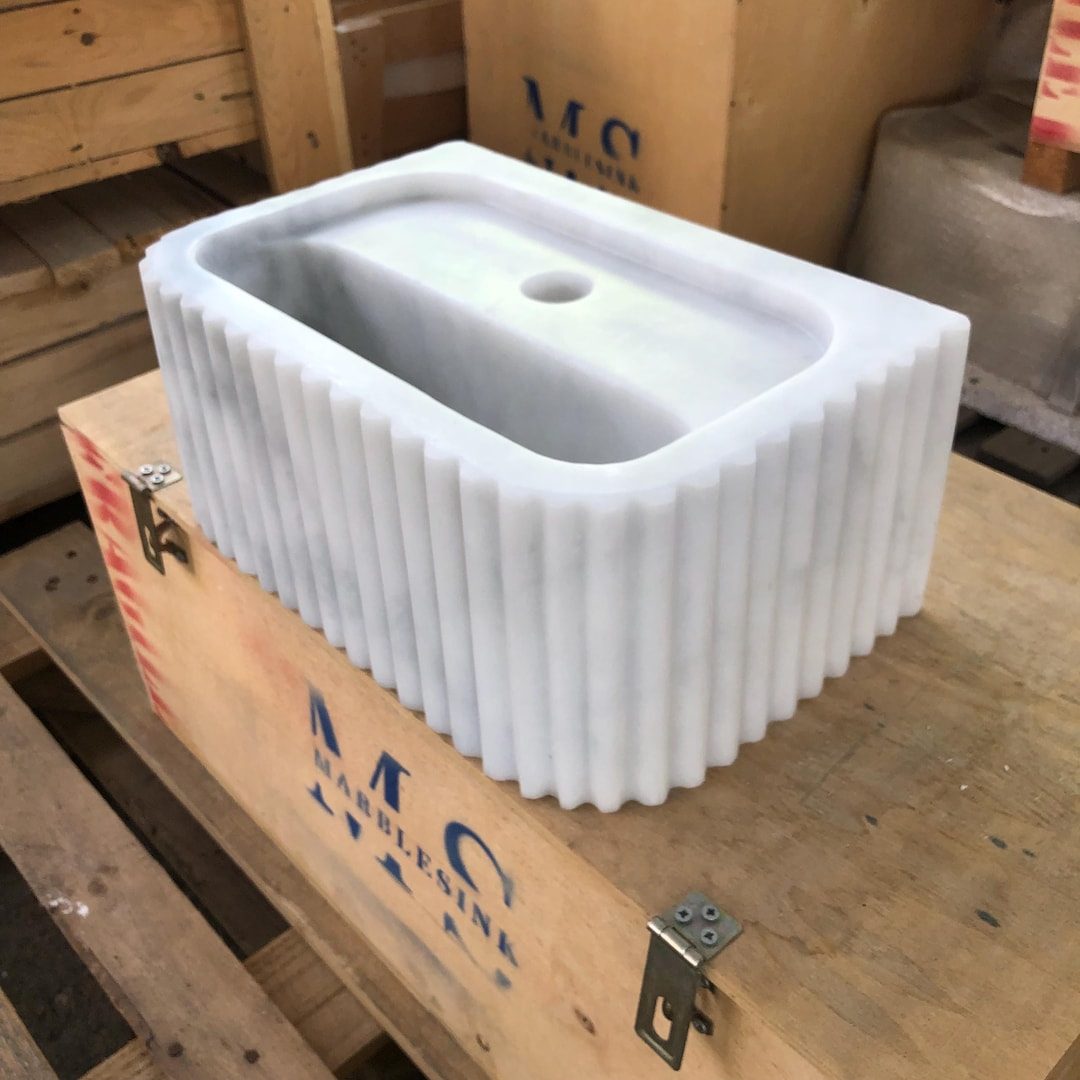
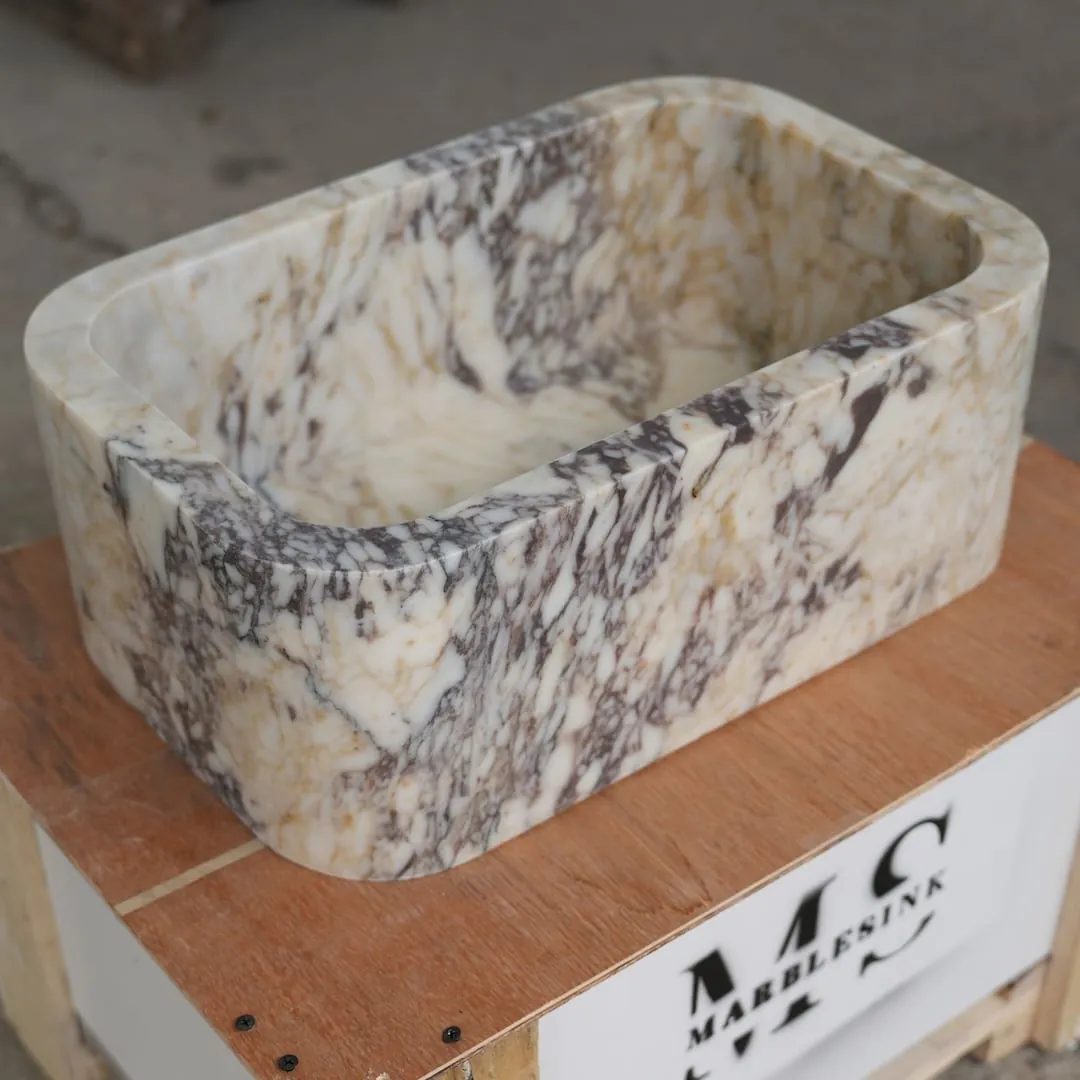
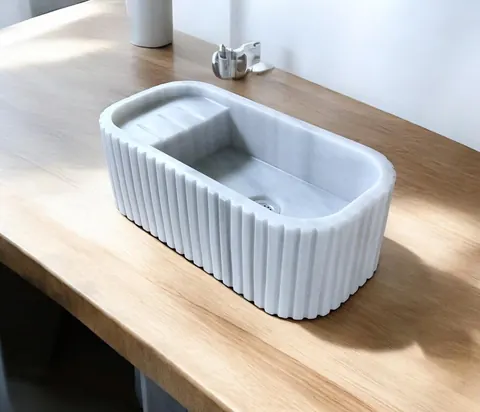
Stone prices also vary the most. Mass-produced bowls sit at the low end. Hand-carved pieces cost more: at MarbleSinkCo, sinks start at $727, most cost $900 to $3,000, each is made to order in about 2 weeks, and there are no returns. Our natural stone sinks hub compares the stones.
Is marble a good material for a bathroom sink?
Marble is a good material for a bathroom sink if you accept simple upkeep. A carved marble sink is solid stone, so it can be made to a custom size and its surface can be re-honed if it is marked. The trade-offs are that acids etch it, it needs sealing about once a year, it is heavy and it costs more than ceramic.
For reference, the median starting price of a hand-carved stone sink in our own listings is $1,196, and the median for sizes 21 to 24 in wide is $1,831, with shipping and US import duties included. The marble sink pros and cons guide sets out both sides, and the marble sink cost guide gives prices by size and stone.
What is the best material for a bathroom sink?
There is no single best material for a bathroom sink. Vitreous china is the usual choice for low cost and low upkeep, fireclay and enameled cast iron take harder use, solid surface is the fastest to clean, and glass and natural stone are chosen for appearance and need more care. Pick by what matters most in that room:
- Lowest cost and upkeep: vitreous china
- Hard daily use: fireclay or enameled cast iron
- Fastest cleaning: solid surface with an integrated bowl
- Appearance first: glass or natural stone, accepting more care
Bathroom sink sizes and clearances
Most bathroom sinks are 16 to 24 in (41 to 61 cm) wide and 5 to 8 in (13 to 20 cm) deep, with the rim 32 to 36 in (81 to 91 cm) above the floor. The clearances around the sink are set by code minimums, and comfortable rooms use more.
| Measurement | Typical figure |
|---|---|
| Width, side to side | 16 to 24 in. Powder room basins from about 12 in. |
| Front to back | 14 to 20 in. Compact basins 10 to 12 in. |
| Round bowl diameter | 14 to 20 in |
| Bowl depth | 5 to 8 in |
| Rim height above the floor | 32 to 36 in. 34 in (86.5 cm) maximum, measured to the rim or counter, for an accessible lavatory under the ADA Standards. |
| Vanity cabinet depth | About 21 in. About 18 in for narrow rooms. |
| Sink centerline to a side wall | 15 in minimum in US model codes. 20 in recommended by NKBA. |
| Clear floor in front | 21 in minimum. 30 in recommended. |
| Two sinks, center to center | 30 in minimum. 36 in recommended. |
The code minimums and NKBA recommendations in this table are as summarized by Bob Vila, and the accessible rim height is from the US Access Board guide to lavatories and sinks, which also requires knee clearance at least 27 in high and protected pipes below an accessible sink. Local code is the final word, so confirm the figures with your building department. Two sinks are comfortable in a vanity about 60 in wide or more. MarbleSinkCo makes single-bowl basins only. Rim height by user and sink type is covered in the bathroom sink height guide.
Faucet hole configurations
The sink and faucet must share the same hole pattern, so choose them together.
| Configuration | Holes | Takes |
|---|---|---|
| Single-hole | 1 hole, commonly 1-3/8 in | Single-handle faucets. Suits small sinks. |
| Centerset | 3 holes, outer two 4 in apart | Compact faucets with spout and handles on one base |
| Widespread | 3 holes, outer two usually 8 in apart | Separate spout and handles. Needs a wider deck. |
| No holes | None | Faucet mounted in the counter or the wall. Usual for vessel and undermount sinks. |
A single-hole faucet can go on a three-hole sink with a deck plate. A widespread faucet cannot go on a centerset sink. US bathroom sinks use a drain with a 1-1/4 in tailpiece, and the drain should have overflow openings only if the sink has an overflow. Stone needs its holes drilled when the sink is made, as explained in the faucet holes, drain and plumbing guide.
How to measure for a bathroom sink
- Measure the existing cutout if you are keeping the countertop: width, front to back, and corner shape. A drop-in sink must fully cover it.
- Measure inside the cabinet. Note the width, the depth, and any drawers or braces. Leave about 3 in of cabinet width beyond an undermount bowl for the cabinet walls and clips.
- Measure the counter depth and the space behind the bowl. The faucet body and its handle both need room.
- Locate the drain. Record the height of the wall stub and its centerline. A bowl far off that line, or much deeper than the old one, means trap changes.
- Count the faucet holes and measure between the centers of the outer two.
- Check clearances: 15 in from the centerline to a side wall, 21 in clear in front, and the door swing.
- Work out the rim height. For a vessel sink, add the bowl height to the counter height.
- Get the weight of any wall-mounted or stone sink. A wall-mounted stone sink must be fixed into studs or solid blocking, never drywall anchors. See stone sink weight and wall support.
Which bathroom sink for which room?
The right bathroom sink depends on how the room is used. A powder room can take a small feature sink in any material, a primary or family bathroom needs a bowl and a material that stand up to daily use, and an accessible bathroom needs a rim at 34 in or lower with knee space below.
| Room | Priorities | Types that fit | Materials that fit |
|---|---|---|---|
| Powder room | Small footprint, appearance, light use | Wall-mounted, pedestal, vessel | Any, including glass and stone |
| Primary bathroom | Daily use, counter space, storage | Undermount or integrated in a vanity | Vitreous china, fireclay, solid surface, sealed stone |
| Kids’ and family bathroom | Impact resistance, fast cleaning | Undermount, integrated, drop-in | Vitreous china, enameled cast iron, solid surface |
| Guest bathroom | Occasional use | Drop-in, vessel, console | Most materials |
| Small full bathroom | Floor space and clearances | Wall-mounted, or an 18 in deep vanity | Vitreous china. Stone if the wall has blocking. |
| Accessible bathroom | Rim at 34 in or lower, knee space below | Wall-mounted or open console | Any, with protected pipes |
| Rental | Low cost, quick replacement | Drop-in or integrated top | Vitreous china, cultured marble |
What a bathroom sink costs in total
The sink is one part of the bill. Add a faucet, a drain, a trap and supply lines, and the plumber’s labor. A like-for-like replacement is the cheapest job. A new countertop cutout, moved pipes or wall blocking cost extra. Labor rates vary by region, so ask a local licensed plumber for a written quote before you buy the sink. The steps for each mounting type are in our guide to installing a bathroom sink.
If natural stone is on your shortlist, every hand-carved design with its sizes and prices can be compared in the sink finder, and current listings are in the MarbleSinkCo Etsy shop.
Sources
- US Access Board, Guide to the ADA Standards: lavatories and sinks: 34 in maximum rim height, knee clearance, pipe protection.
- Bob Vila, The Basics of Good Bathroom Design: code minimum and NKBA recommended clearances.
- Geology.com, Mohs hardness scale: hardness of calcite.
- Natural Stone Institute, Care and Cleaning of Natural Stone: cleaners for calcium-based and siliceous stone.
- MarbleSinkCo, Stone Sink Price Index: stone sink prices in this article.
Frequently Asked Questions
What is the best material for a bathroom sink?+
There is no single best material. Vitreous china is the usual choice for low cost and low upkeep. Fireclay and enameled cast iron take harder use. Solid surface gives a seamless integrated bowl. Glass and natural stone are chosen for looks and need more care: glass shows water spots, and marble needs sealing and pH-neutral cleaner.
What is the standard size of a bathroom sink?+
Most bathroom sinks are 16 to 24 in (41 to 61 cm) wide, 14 to 20 in (36 to 51 cm) front to back and 5 to 8 in (13 to 20 cm) deep. Round bowls are usually 14 to 20 in across. Powder room basins can be as narrow as 12 in (30 cm). The finished rim normally sits 32 to 36 in (81 to 91 cm) above the floor.
Is an undermount or drop-in sink better?+
An undermount sink is easier to keep clean, because water and spills wipe straight from the counter into the bowl. It needs a solid counter such as stone, quartz or solid surface. A drop-in sink costs less to install, works with laminate and is simple to replace, but its rim creates a joint that collects grime.
What type of bathroom sink is easiest to keep clean?+
An integrated sink, where the bowl and countertop are one piece, is the easiest because there is no joint at all. An undermount sink is next. For material, glazed vitreous china tolerates almost any non-abrasive bathroom cleaner. Vessel sinks and drop-in sinks take the most wiping around the base or rim.
How do I know which faucet fits my bathroom sink?+
Count the holes and measure between the centers of the outer two. One hole takes a single-hole faucet. Three holes 4 in apart take a centerset faucet. Three holes about 8 in apart take a widespread faucet. Sinks with no holes need a faucet mounted in the counter or the wall.
How much should I spend on a bathroom sink?+
A glazed vitreous china sink is the lowest-cost choice and is enough for most bathrooms. Fireclay, enameled cast iron and solid surface cost more, and natural stone costs the most. As a reference for stone, hand-carved sinks at MarbleSinkCo start at $727, with a median starting price of $1,196. Budget separately for the faucet, drain, trap and installation.
Is marble a good material for a bathroom sink?+
Marble is a good bathroom sink material if you accept simple upkeep. A carved marble sink is solid stone, can be made to a custom size and can be re-honed if it is marked. In return, acids such as vinegar etch it, it needs a penetrating sealer about once a year, it is heavy and it costs more than ceramic.
Share this article